Research data
Combine work records and surveys
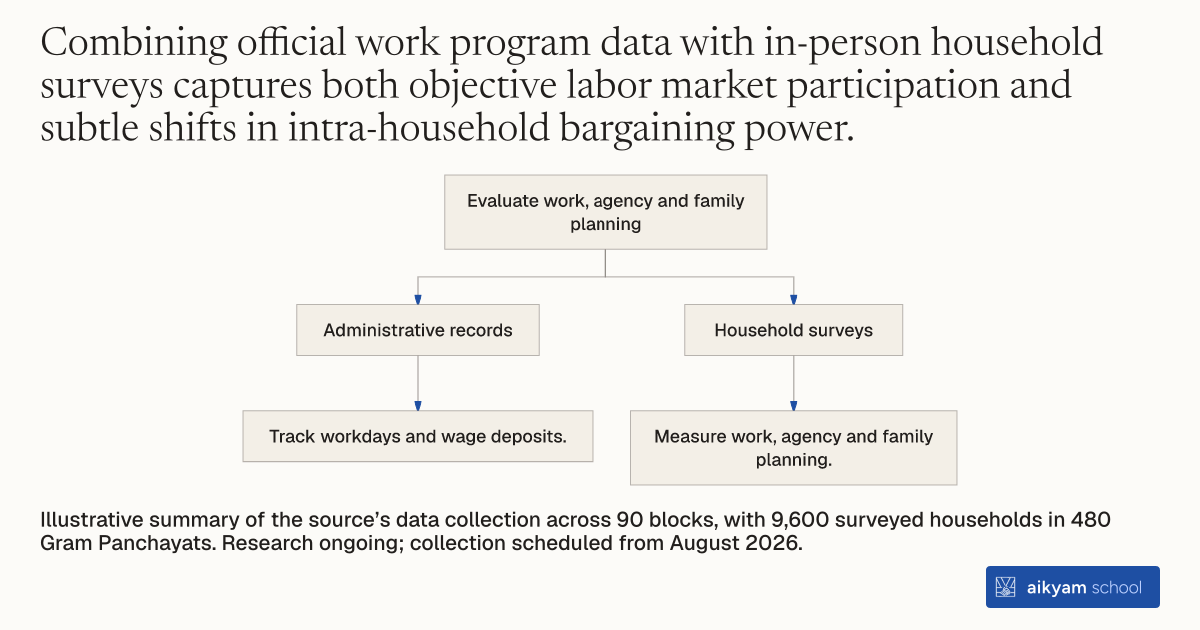
Evaluate work, agency and family planning
- Administrative records
- Track workdays and wage deposits.
- Household surveys
- Measure work, agency and family planning.
Illustrative summary of the source’s data collection across 90 blocks, with 9,600 surveyed households in 480 Gram Panchayats. Research ongoing; collection scheduled from August 2026.
See source →How
When to use
In rural development evaluations, relying on a single data source or short-term metric often fails to capture how economic programs alter female empowerment and health choices. Complex interventions that combine bank account linkages with work scheme training require evaluating both direct labor outcomes and broader household dynamics. This method combines government administrative records with comprehensive household surveys to measure labor market, financial agency, and family planning impacts among rural women.
Combine administrative work scheme records with primary household surveys to evaluate female labor participation, financial decision-making, and family planning outcomes across target and comparison blocks.
- Evaluators assign district blocks to distinct intervention groups and a non-surveyed administrative tracking group to conserve survey budgets.
- Field researchers collect baseline and follow-up survey data across 9,600 randomly selected households in 480 Gram Panchayats.
- Analysts pull government MGNREGS administrative records to track employment days and direct deposit wage payouts across assigned blocks.
- Surveyors measure female economic agency, including earnings, private sector job types, household decision-making power, spending patterns, mental health, and gender attitudes.
- Surveyors record detailed reproductive health metrics, including contraceptive use, unmet family planning needs, desired fertility timing, and perceived spouse or in-law beliefs.
Why it works
Tracking reproductive choices alongside income control reveals whether economic independence directly translates into reproductive agency for women.
Example
Researchers from J-PAL and Inclusion Economics India Centre implemented this evaluation across 90 blocks in Madhya Pradesh, India. Starting in August 2026, evaluators gather survey data across 9,600 households in 480 Gram Panchayats alongside administrative MGNREGS data to assess outcomes across 30 direct deposit blocks, 30 direct deposit plus training blocks, and 30 comparison blocks.
About the study
Participants
9,600 households surveyed across 480 Gram Panchayats in 90 blocks of Madhya Pradesh, India, where 57 percent of surveyed women were aged 15 to 49.
Study Design
Clustered Randomized Controlled Trial across 90 blocks, assigning 30 blocks to administrative record tracking only, 30 blocks to direct deposit plus training with 6,000 surveyed households, and 30 blocks to comparison with 3,600 surveyed households.
Results
Research is ongoing with data collection scheduled for August 2026 to measure impacts on workdays, earnings, contraceptive use, fertility gaps (rural gap of 0.43 children per woman at baseline), and household agency.