Research steps
Verify interviews with employers
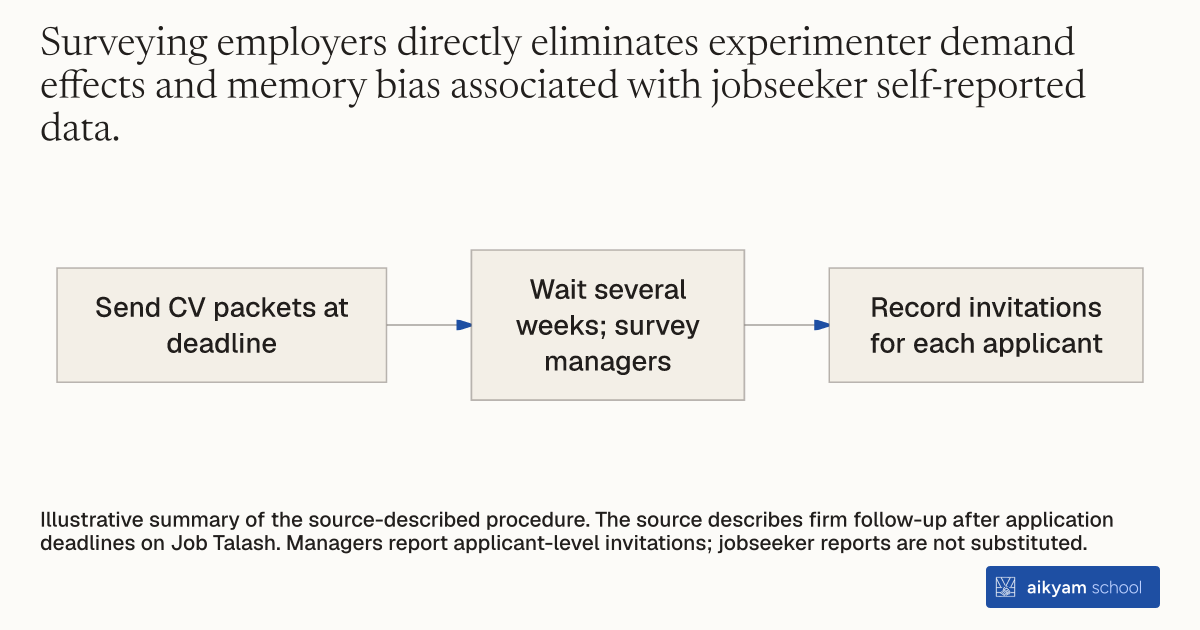
- Send CV packets at deadline
- Wait several weeks; survey managers
- Record invitations for each applicant
Illustrative summary of the source-described procedure. The source describes firm follow-up after application deadlines on Job Talash. Managers report applicant-level invitations; jobseeker reports are not substituted.
See source →How
When to use
Job matching platforms often rely on jobseeker self-reports to track interview outcomes, introducing social desirability bias and measurement error. Surveying employers directly after application deadlines verifies interview invitations independently from jobseeker responses. It is intended for employment platforms and researchers seeking unbiased objective measures of job candidate interview rates.
Measure interview outcomes by surveying recruiting managers at participating firms shortly after job application deadlines pass.
- Compile candidate application packets containing standardized resumes for each posted vacancy at the application deadline.
- Transmit the compiled candidate resume packets directly to hiring managers at participating firms.
- Allow a period of several weeks to elapse after the application deadline for hiring managers to review candidates and schedule interviews.
- Contact hiring managers by telephone or in person using a structured survey instrument.
- Inquire whether the firm invited each specific applicant listed in the application packet to an interview.
- Record firm reports of interview invitations to construct objective, employer-verified candidate interview indicators.
Why it works
Because employers are unaware of individual jobseekers' experimental treatment status, firm-reported interview tracking guarantees unbiased outcome measurement.
Example
In Lahore, Pakistan, the Job Talash research team surveyed 1,340 participating firms a few weeks after monthly application deadlines to verify which candidates received interview invitations. Firm tracking confirmed that phone call outreach increased interview invitations from 0.012% to 0.090% per match while maintaining an overall interview conversion yield of 5.9%.
About the study
Participants
N = 1,340 employer vacancies (1,116,952 jobseeker-vacancy matches) across commercial sectors in Lahore, Pakistan.
Study Design
Observational employer survey tracking embedded within a field experiment, interviewing firm hiring managers several weeks post-deadline to verify candidate interview invitations.
Results
Direct firm tracking verified that treatment increased match-level interview invitations from 0.012% to 0.090% (effect = 0.00078, p < 0.001) and established that marginal applications yielded a 5.87% interview invitation rate (p = 0.647 relative to 6.29% control rate).