Research procedure
Maintain the flat raise comparison contract
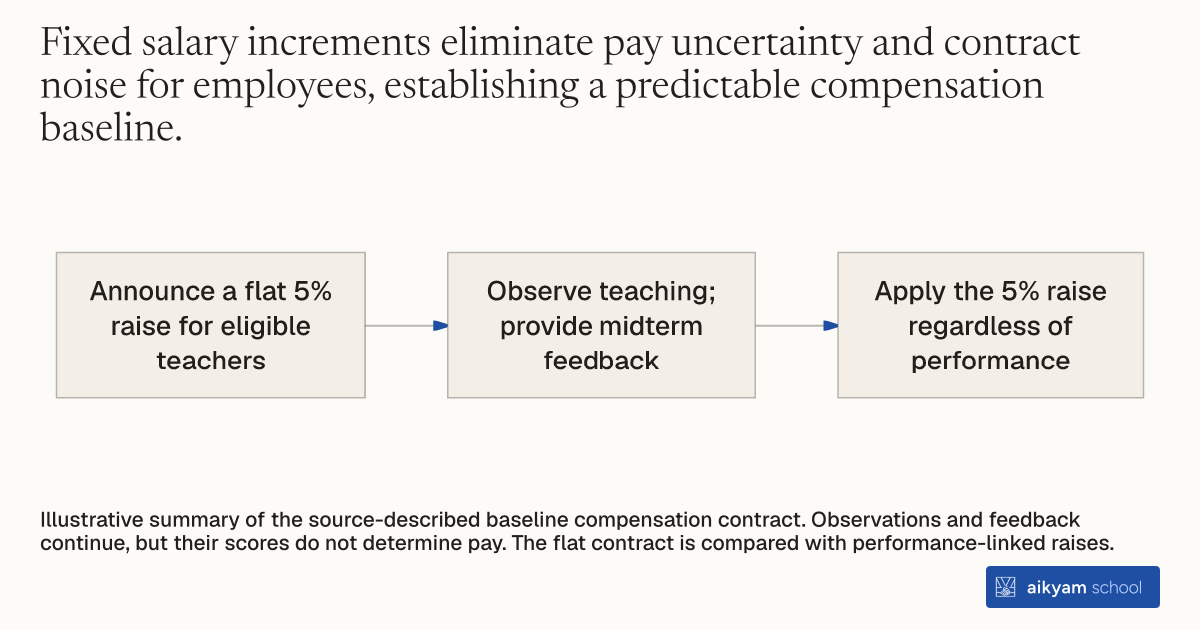
- Announce a flat 5% raise for eligible teachers
- Observe teaching; provide midterm feedback
- Apply the 5% raise regardless of performance
Illustrative summary of the source-described baseline compensation contract. Observations and feedback continue, but their scores do not determine pay. The flat contract is compared with performance-linked raises.
See source →How
When to use
School systems require a benchmark compensation contract to maintain workforce stability without introducing performance-contingent financial stakes. Tying pay increases to non-contingent flat increments establishes a control baseline against which discretionary or test-score incentive schemes can be evaluated.
Provide all eligible core teachers with an equal, fixed percentage salary increment at the end of the annual review cycle regardless of individual performance metrics.
- Establish baseline salary levels and eligibility criteria for core subject teachers prior to the start of the academic year.
- Announce the flat increment policy through human resources presentations and portal notices, clarifying that all eligible staff receive the same standard raise percentage.
- Conduct standard administrative tasks and classroom observations throughout the twelve-month cycle without tying observation scores to compensation.
- Provide teachers with midterm performance feedback notifications to keep information provision constant across baseline and incentive groups.
- Disburse the unconditional fixed percentage salary raise to all eligible core teachers at the end of the annual review cycle.
Why it works
This baseline contract allows organizations to isolate whether variable performance raises generate genuine productivity gains beyond standard non-contingent pay increases.
Example
A private school system in Pakistan provided core teachers across control schools with an unconditional flat salary raise of 5% at the end of a twelve-month review cycle. Teachers under this flat raise baseline recorded an average of 144.79 days present at work and spent 0.14 minutes per 20-minute observation segment on test preparation activities.
About the study
Participants
6,080 teachers (80% female), 189 managers, and 141,566 student-subject test observations across 234 private schools in Pakistan (grades 4–13).
Study Design
Randomized controlled trial (RCT) comparing a flat 5% raise control group against manager-discretionary subjective performance raises (0–10%) and percentile value-added objective raises (0–10%) in within-school tournaments over an 18-month intervention.
Results
Teachers in the flat 5% raise control group recorded a baseline student endline test score mean of -0.04 z-scores, spent 0.14 minutes per 20-minute segment on test prep, and averaged 144.79 days present at school per year.