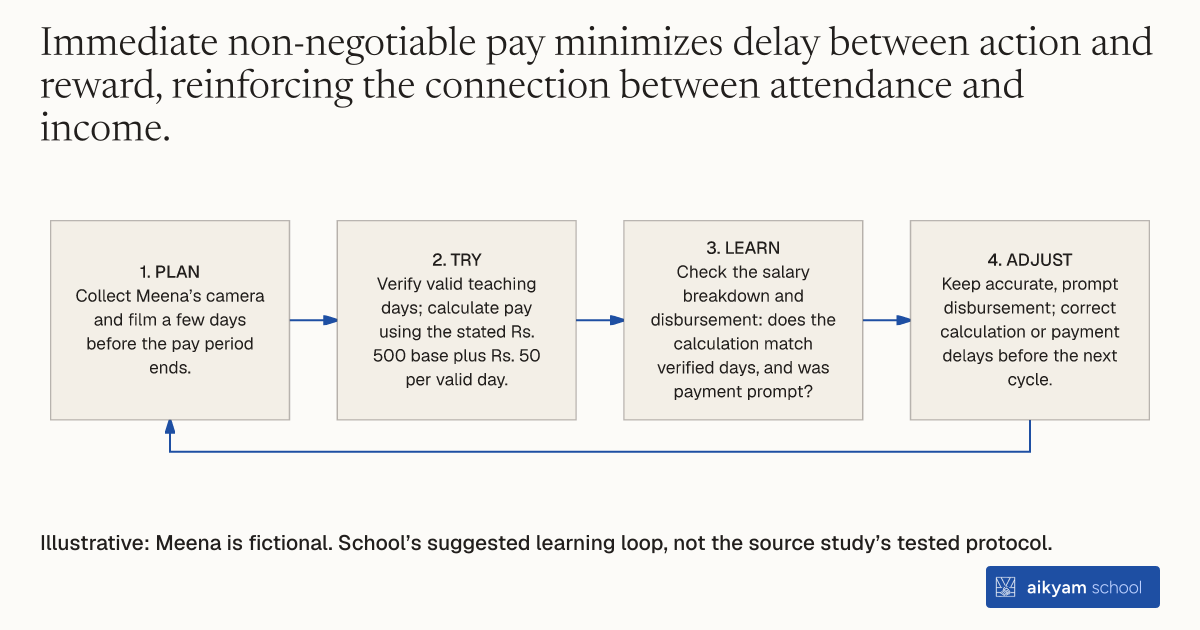
Try, learn and adjust
Check pay calculations and prompt payment
- Plan: Collect Meena’s camera and film a few days before the pay period ends.
- Try: Verify valid teaching days; calculate pay using the stated Rs. 500 base plus Rs. 50 per valid day.
- Learn: Check the salary breakdown and disbursement: does the calculation match verified days, and was payment prompt?
- Adjust: Keep accurate, prompt disbursement; correct calculation or payment delays before the next cycle.
Illustrative: Meena is fictional. School’s suggested learning loop, not the source study’s tested protocol.
See source →School’s suggested learning loop, not a tested protocol. Observe valid-day counts, payment timing and the written breakdown supplied with the first paycheck.
How
When to use
Incentive programs often fail when payment calculations are opaque or delayed, causing worker confusion and lack of trust in performance rewards. When teachers do not understand how pay connects to attendance, financial incentives lose their motivating power. Transparent calculation and rapid disbursement ensure educators immediately link their actions to monetary rewards.
Calculate teacher compensation through simple non-negotiable rules and disburse pay promptly at the end of each monthly cycle.
- Collect cameras and film from teachers a few days before the end of each pay period.
- Verify daily photos against attendance rules to count the exact number of valid teaching days.
- Calculate final pay automatically using the base rate of Rs. 500 plus Rs. 50 per valid day taught.
- Issue immediate paycheck disbursements without delay following camera collection.
- Provide each teacher with a detailed written breakdown explaining the exact salary calculation upon delivering their first paycheck.
Why it works
Transparent calculation explanations eliminate ambiguity, giving teachers complete understanding and control over their earnings.
Example
In rural Udaipur, India, Seva Mandir collected cameras shortly before the end of each pay period and provided teachers with written pay calculation breakdowns upon receiving their first paycheck, leading teachers to better understand the program while average teacher pay matched former salary levels.
About the study
Participants
Single-teacher informal primary schools in rural Udaipur, India, each teaching about 20 students.
Study Design
Randomized evaluation of a camera-monitored performance pay program with rapid paycheck disbursement and transparent fee structure explanations compared against standard monthly fixed salaries.
Results
Teachers in the camera program had an average absence rate of 21 percent compared to 42 percent in the control group, and 36 percent of camera teachers attended at least 90 percent of school days compared to only one teacher in the control group.