Research design
Explore community contribution pressures
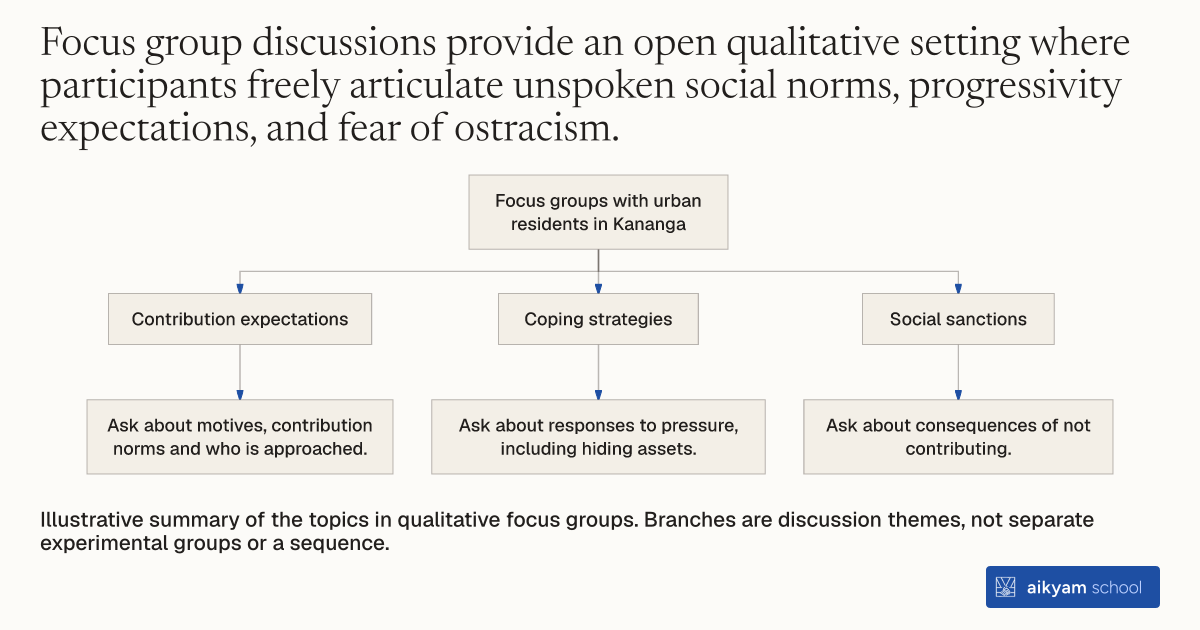
Focus groups with urban residents in Kananga
- Contribution expectations
- Ask about motives, contribution norms and who is approached.
- Coping strategies
- Ask about responses to pressure, including hiding assets.
- Social sanctions
- Ask about consequences of not contributing.
Illustrative summary of the topics in qualitative focus groups. Branches are discussion themes, not separate experimental groups or a sequence.
See source →How
When to use
In urban developing contexts, quantitative survey metrics alone may fail to capture the subtle social norms, progressive expectations, and informal sanctions associated with community contributions. Researchers and program designers need to understand the underlying mechanisms and perceived costs driving citizens' participation in horizontal social institutions. Conducting structured qualitative focus group discussions reveals qualitative insights into door-to-door solicitations, social pressure, asset concealment, and fears of community ostracism.
Gather qualitative evidence on informal social obligations by conducting structured focus group discussions with local citizens.
- Convene focus groups composed of urban residents across diverse neighborhoods as described in Section 3.2.2.
- Ask open-ended questions examining the social norms and motivations surrounding contributions to churches, weddings, funerals, and community public works.
- Probe how contribution expectations are determined and whether solicitations target specific demographics, such as wealthier households.
- Elicit descriptions of coping strategies used by residents facing redistributive pressures, including asset-concealing behaviors.
- Inquire about the specific informal social sanctions and psychological consequences imposed on individuals who fail to satisfy community expectations.
Why it works
This surfaces social dynamics and informal enforcement mechanisms that standard structured quantitative surveys miss.
Example
Researchers conducted focus group interviews with citizens in Kananga, DRC, revealing that door-to-door solicitations target wealthier residents, leading citizens to conceal assets, while non-contributors face gossip, mistrust, and community isolation.
About the study
Participants
Urban residents in Kananga, Democratic Republic of Congo, participating in qualitative focus group discussions alongside a main study sample of 4,343 survey respondents.
Study Design
Qualitative focus group interviews conducted to evaluate the mechanisms, social sanctions, and asset-concealing behaviors surrounding horizontal social institutions within a randomized land titling evaluation.
Results
Qualitative focus groups revealed that social contributions follow a progressivity norm targeting wealthier households, driving asset concealment ("salary is secret") and social sanctions including mistrust, gossip, and community ostracism.