Research procedure
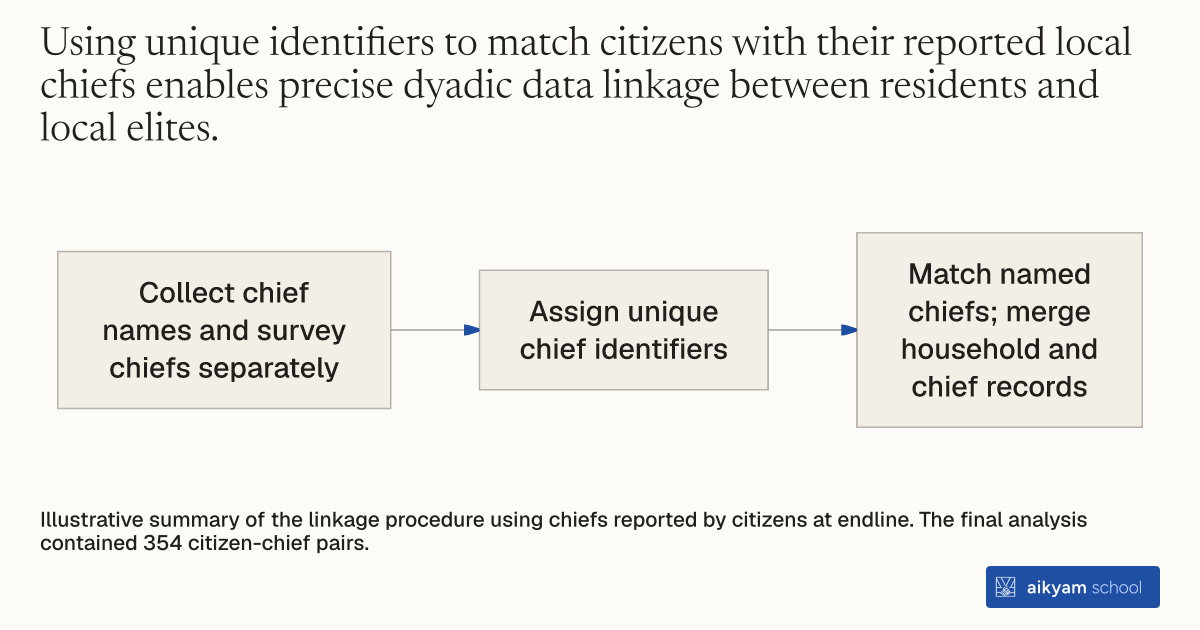
Link households to their named chiefs
- Collect chief names and survey chiefs separately
- Assign unique chief identifiers
- Match named chiefs; merge household and chief records
Illustrative summary of the linkage procedure using chiefs reported by citizens at endline. The final analysis contained 354 citizen-chief pairs.
See source →How
When to use
In urban governance research, analyzing the influence of local non-state elites requires linking individual citizen survey data directly to their specific local leaders. Surveying residents and local chiefs separately leaves researchers without verified dyads connecting households to their governing authorities. Survey teams collect citizen self-reports of local chief identities and use unique alphanumeric identifiers to match residents directly to surveyed chiefs.
Link citizen survey responses to local chief data by collecting chief names during household surveys and assigning matching unique identifiers across separate survey datasets.
- Administer household surveys asking respondents to identify their specific local avenue or neighborhood chief.
- Conduct a separate comprehensive survey of city chiefs across urban jurisdictions to collect chief background and administrative characteristics as described in Section 5.
- Assign a standardized unique identifier code to each surveyed chief and local administrative unit.
- Review citizen survey responses to identify the chief named by each respondent.
- Merge household survey records with chief survey records using the unique chief identifier.
Why it works
This allows researchers to analyze how citizen-chief connections and chief characteristics affect household-level policy outcomes.
Example
Researchers in Kananga, DRC, surveyed over 1,000 city chiefs and matched them to household survey respondents using unique identifiers based on the chief reported by citizens at endline.
About the study
Participants
Over 1,000 city chiefs and 4,343 household survey respondents in Kananga, Democratic Republic of Congo, with 354 citizen-chief dyads in the final analysis sample.
Study Design
Separate chief and household surveys merged via unique chief identifiers to examine heterogeneous treatment effects in a randomized land titling field experiment.
Results
Citizens knowing their chief's name increased land titling program initiation by 13.7 percentage points, while having a chief affiliated with a political party reduced title receipt by 5.9 percentage points.