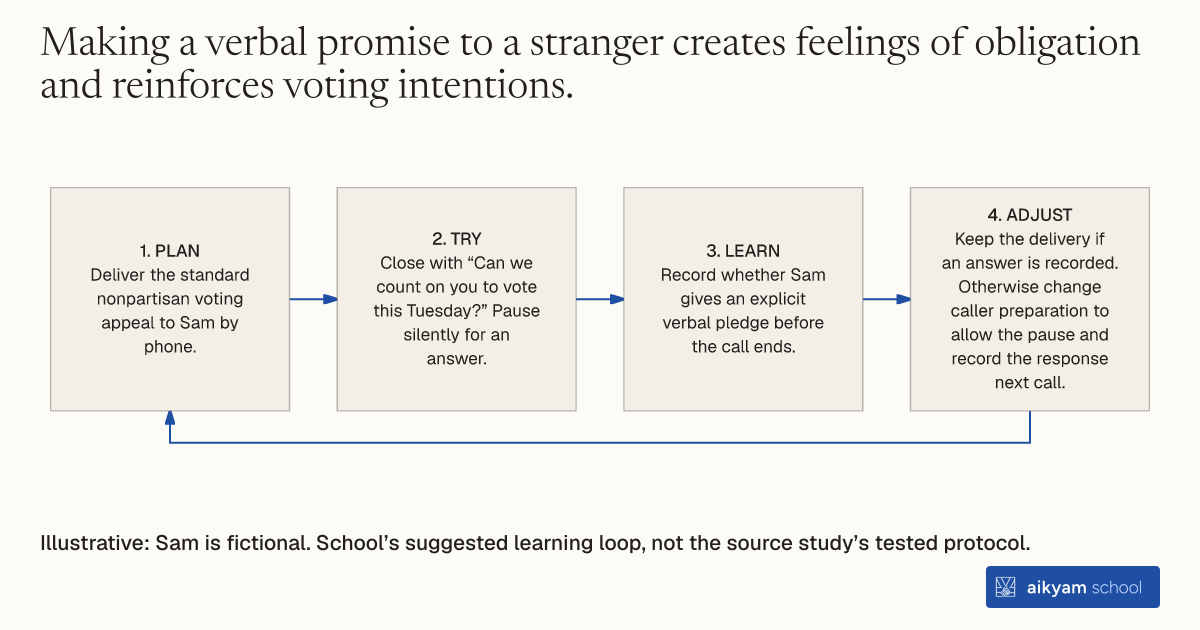
Try, learn and adjust
Check whether a voter answers the pledge question
- Plan: Deliver the standard nonpartisan voting appeal to Sam by phone.
- Try: Close with “Can we count on you to vote this Tuesday?” Pause silently for an answer.
- Learn: Record whether Sam gives an explicit verbal pledge before the call ends.
- Adjust: Keep the delivery if an answer is recorded. Otherwise change caller preparation to allow the pause and record the response next call.
Illustrative: Sam is fictional. School’s suggested learning loop, not the source study’s tested protocol.
See source →Observe answers and recorded pledges. The source reports only a small, statistically non-significant turnout improvement from adding the question. School’s suggested learning loop; not a tested source procedure.
How
When to use
Standard get-out-the-vote phone messages simply state information or encourage turnout without securing a commitment. Voters who passively receive advice often fail to follow through on election day. Asking respondents for an explicit verbal commitment encourages them to affirm their voting intention.
Append a direct intention-affirming question to the end of a phone mobilization script to elicit a verbal commitment from the voter.
- Deliver the standard get-out-the-vote informational appeal over the phone to the target voter.
- Replace generic closing statements with the specific question: "Can we count on you to vote this Tuesday?"
- Pause after delivering the question and wait silently for the respondent to state an answer.
- Record whether the voter gives an explicit verbal pledge to vote before concluding the call.
Why it works
Asking individuals to affirm their intention boosts commitment among prospective participants.
Example
During the 1998 general election in West Haven, Connecticut, callers asked 5,229 registered voters in the GOTV treatment group the follow-up pledge question "Can we count on you to vote this Tuesday?" while 3,595 voters received the default closing statement. The inclusion of the pledge question yielded a small, statistically non-significant increase in mobilization effectiveness compared to standard GOTV calls.
About the study
Participants
5,229 registered voters assigned to receive the follow-up pledge question out of 8,824 total GOTV treatment subjects in West Haven, CT.
Study Design
Randomized controlled trial embedded within a phone mobilization experiment to compare voters receiving a pledge request against voters receiving a standard closing statement.
Results
Adding the participation pledge question produced a small, statistically non-significant boost in turnout compared to calls without the pledge question.