Try, learn and adjust
Check earned wages reach individual bank accounts
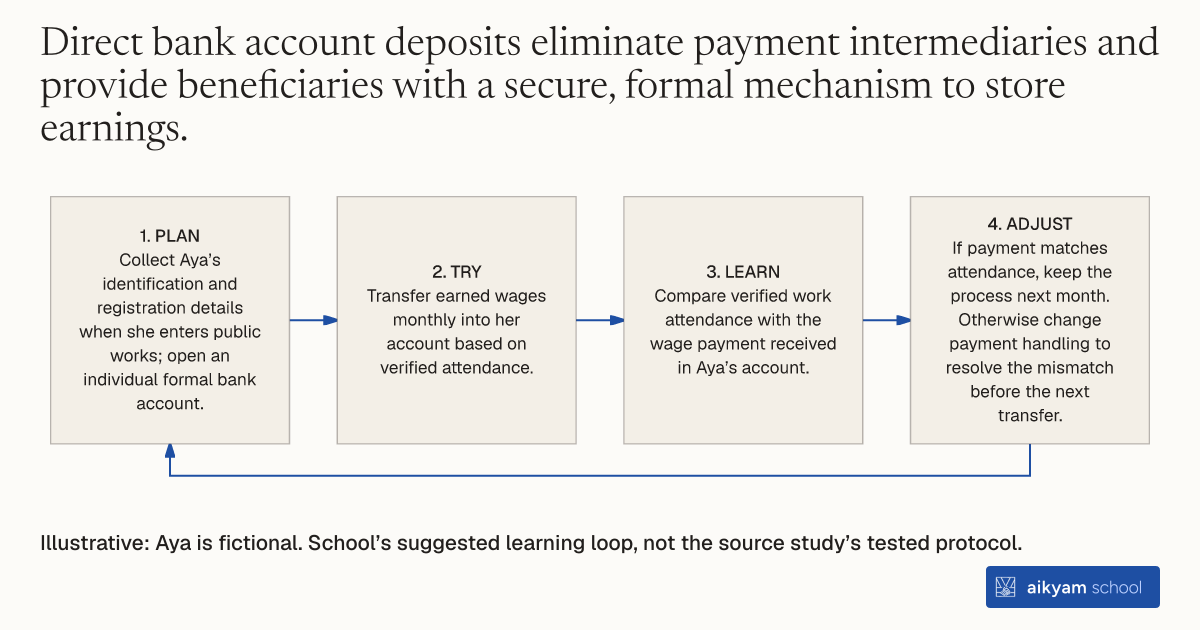
- Plan: Collect Aya’s identification and registration details when she enters public works; open an individual formal bank account.
- Try: Transfer earned wages monthly into her account based on verified attendance.
- Learn: Compare verified work attendance with the wage payment received in Aya’s account.
- Adjust: If payment matches attendance, keep the process next month. Otherwise change payment handling to resolve the mismatch before the next transfer.
Illustrative: Aya is fictional. School’s suggested learning loop, not the source study’s tested protocol.
See source →Observe attendance-based wages and account receipt. Participants may withdraw money or leave savings; no saving outcome is assumed. School’s suggested learning loop; not a tested source procedure.
How
When to use
Low-income urban youth often lack access to formal financial services and bank accounts, storing savings informally or unreliably. Opening formal bank accounts to disburse workfare wages provides a secure payment channel and introduces unbanked workers to formal banking institutions. This method serves young public works participants in developing countries during temporary employment interventions.
Open formal individual bank accounts for workfare participants upon enrollment to facilitate monthly wage transfers and formal savings.
- Collect identification and registration details for all enrolled workfare participants upon program entry.
- Coordinate with financial institutions to set up individual formal bank accounts for every participant.
- Transfer monthly earned wages directly into participants' individual bank accounts based on verified work attendance.
- Allow participants to withdraw cash for daily expenditures or maintain formal savings balances throughout and after the program.
Why it works
The account infrastructure lowers the cost of saving and encourages participants to retain accumulated wage gains in formal financial institutions.
Example
In Côte d'Ivoire, the PEJEDEC project opened formal bank accounts for 3,125 youth enrolled in public works across 16 urban localities. Participants received monthly payments of 2,500 CFA francs per day worked directly into these accounts over a seven-month period. Most beneficiaries retained their savings in these formal bank accounts, increasing total savings stocks significantly during and after the program.
About the study
Participants
4,160 urban youth aged 18 to 30 years across 16 localities in Côte d'Ivoire, with 43% women and 49% having not completed primary school.
Study Design
Randomized controlled trial comparing 3,125 public works participants selected by lotteries against 1,035 non-selected control applicants, evaluated during participation and 12 to 15 months post-program.
Results
At midline (4 to 5 months in), the program increased average savings stocks by 39,786 CFA francs (a 182% increase over the control average of 19,250 CFA francs), with most savings held in the formal bank accounts opened by the program. At endline (12 to 15 months post-program), treated youth maintained a significantly higher savings stock by 11,505 CFA francs compared to the control group.