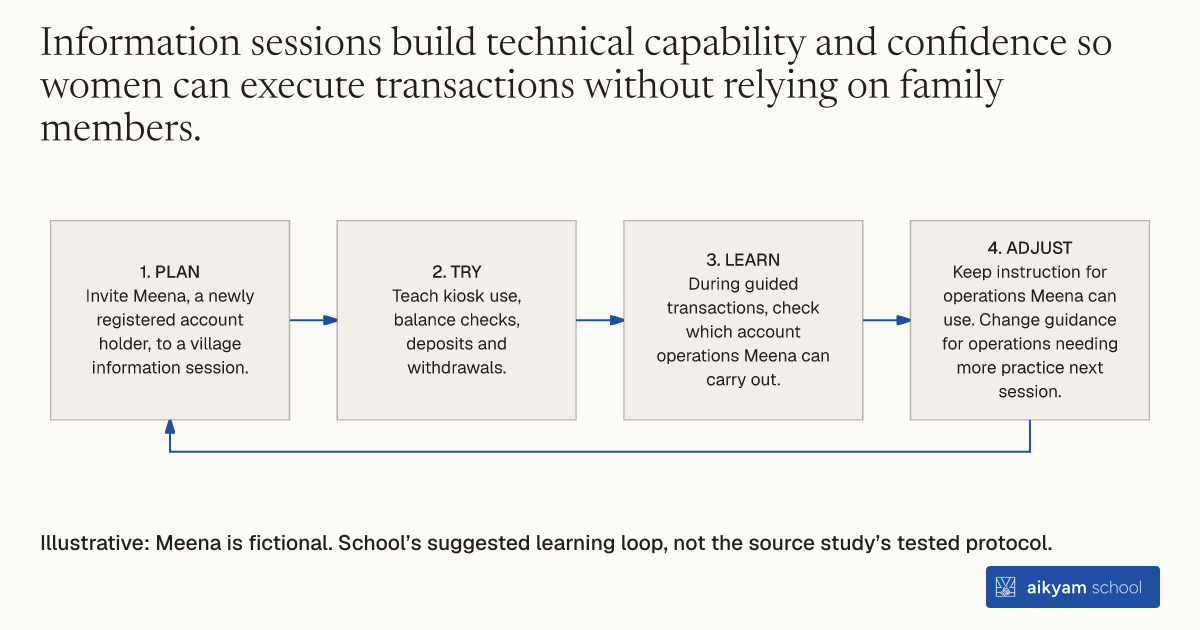
Try, learn and adjust
Check practice with personal bank accounts
- Plan: Invite Meena, a newly registered account holder, to a village information session.
- Try: Teach kiosk use, balance checks, deposits and withdrawals.
- Learn: During guided transactions, check which account operations Meena can carry out.
- Adjust: Keep instruction for operations Meena can use. Change guidance for operations needing more practice next session.
Illustrative: Meena is fictional. School’s suggested learning loop, not the source study’s tested protocol.
See source →School’s suggested, untested loop. Observe account operations practised. Effects of the combined account, deposit and training package are not training-only effects.
How
When to use
Rural women given bank accounts often lack experience operating financial services independently. Conducting targeted literacy and instruction sessions teaches account holders how to deposit, withdraw, and manage money. This method serves newly banked women in low-income rural communities.
Invite newly registered women to dedicated information sessions on operating personal bank accounts at local kiosks.
- Program staff identify rural women who recently registered for personal bank accounts across targeted village clusters.
- Trainers host interactive information sessions in village clusters to explain account operations.
- Instructors teach participants how to navigate local banking kiosks and execute financial transactions.
- Field staff guide attendees through checking balances, making deposits, and withdrawing personal wages.
Why it works
Combining account knowledge with access grants women actual control over their finances.
Example
In Madhya Pradesh, India, field staff invited newly banked women across rural village clusters to financial literacy sessions on using local kiosk banking services.
About the study
Participants
5,851 women in 197 gram panchayats across Gwalior, Morena, Shivpuri, and Sheopur districts in Madhya Pradesh, India.
Study Design
Randomized controlled trial across 197 village clusters evaluating bank account access, direct deposits, and training using baseline, 2015 short-run, and 2017 long-run surveys.
Results
Assigning women to accounts, direct deposits, and training resulted in a 0.12 standard deviation increase in female banking autonomy and a 0.08-0.09 standard deviation liberalization in perceived gender norms.