Procedure
Individual counselling
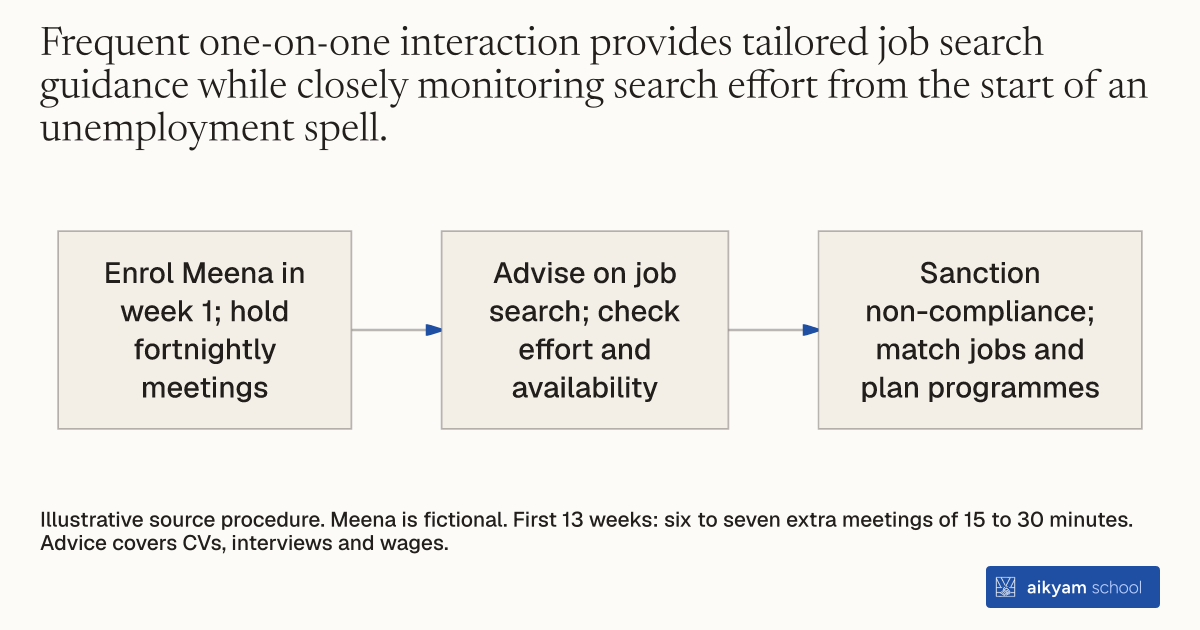
- Enrol Meena in week 1; hold fortnightly meetings
- Advise on job search; check effort and availability
- Sanction non-compliance; match jobs and plan programmes
Illustrative source procedure. Meena is fictional. First 13 weeks: six to seven extra meetings of 15 to 30 minutes. Advice covers CVs, interviews and wages.
See source →How
When to use
Newly registered unemployed workers need early support to return to regular employment quickly without suffering from lock-in effects. Traditional activation schemes are expensive and often delay return to regular work during the early stages of unemployment. Mandatory biweekly individual counselling provides frequent one-on-one guidance and search monitoring during the first 13 weeks of unemployment.
Conduct individual counselling sessions every two weeks between a caseworker and a newly unemployed worker during the first 13 weeks of unemployment.
- Job centre officials enrol newly registered unemployment insurance recipients into biweekly individual meeting schedules during their first week of unemployment.
- Caseworkers conduct individual one-on-one meetings lasting 15 to 30 minutes with each participant every two weeks for a total of six to seven extra meetings.
- Caseworkers advise the job seeker on effective job search channels, CV preparation, interview readiness, and realistic wage expectations.
- Caseworkers evaluate search efforts, confirm availability for work, and apply sanctions when participants fail to comply with search requirements.
- Caseworkers match participants directly to specific local job vacancies and plan future participation in active labour market programmes.
Why it works
Regular meetings also help job seekers retain jobs longer once re-employed.
Example
In Copenhagen and Sealand, job centres in Gribskov, Roskilde, Ishøj-Vallensbæk, Holbæk, and Vordingborg assigned 832 newly unemployed workers to fortnightly individual meetings for 13 weeks, resulting in five extra meetings on average and 7.4 extra weeks of accumulated employment after 237 weeks.
About the study
Participants
1,637 Danish unemployment insurance recipients (832 treatment, 805 control) in Copenhagen and Sealand.
Study Design
Randomized field experiment comparing fortnightly individual meeting participants against a control group receiving standard treatment, tracking outcomes over 237 weeks using administrative event history registers.
Results
Treated participants gained 7.4 extra weeks of accumulated employment over 237 weeks, representing a 5.7 percent increase in employment, while improving the government budget by a net discounted 4,457 euros per unemployed worker.