In Simple Words
Imagine giving a traveler a vehicle to a destination miles away but expecting them to drive without ever teaching them how to operate a car. Providing hardware (a tablet and internet connection) combined with intensive driving lessons (100 hours of hands-on digital skills instruction) equips job seekers to navigate digital highways toward employment opportunities and administrative benefits independently.
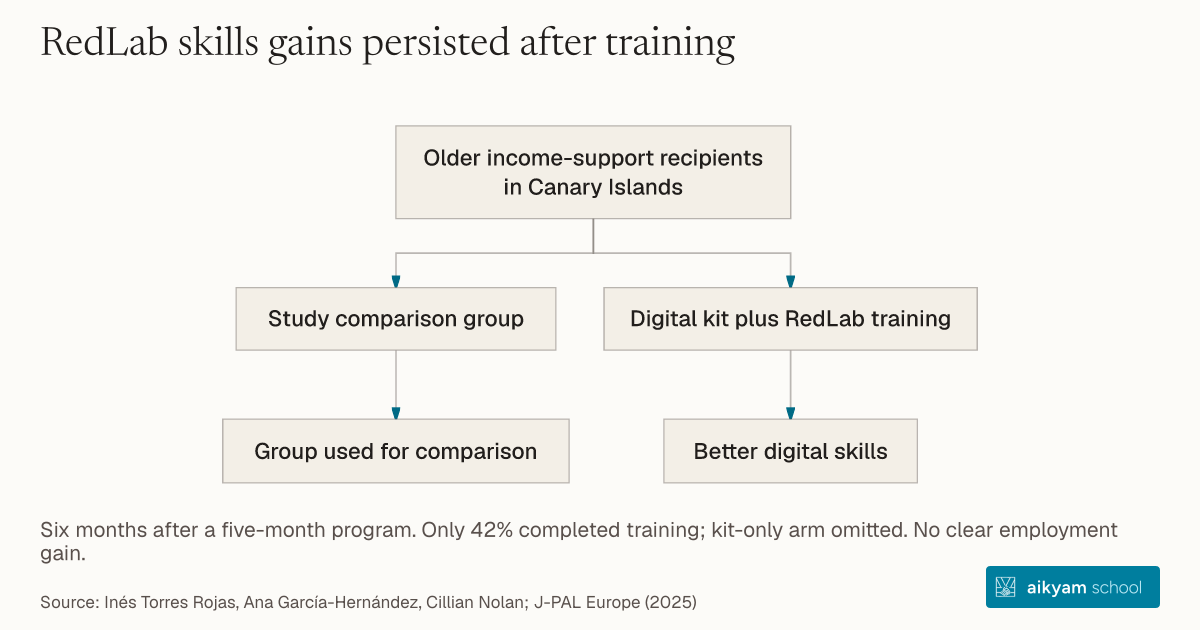
Older income-support recipients in Canary Islands
- Study comparison group
- Group used for comparison
- Digital kit plus RedLab training
- Better digital skills
Six months after a five-month program. Only 42% completed training; kit-only arm omitted. No clear employment gain.
See source →Research question
Economically disadvantaged job seekers frequently experience severe digital exclusion, with nearly half of individuals earning under €900 per month lacking basic digital competencies, preventing them from accessing digitised employment portals and online public administration services.
Participants
2,968 minimum income recipients aged 45–65 without secondary education in the Canary Islands, Spain (988 Digital Kit only, 994 RedLab combined, 986 comparison).
Study Design
Randomised Controlled Trial (RCT) testing a 5-month intervention featuring 100 hours of in-person digital training, job counselling, a 30-hour internship, and a hardware/internet kit.
Results
The combined digital literacy program generated statistically significant and durable improvements in digital skills, job search intensity, self-perceived employability, and life satisfaction persisting 6 months post-intervention, whereas hardware provision alone yielded substantially smaller effects and neither treatment significantly increased short-term employment rates.
Takeaway
Pair hardware equipment grants with mandatory, intensive hands-on digital literacy instruction to enable low-educated older welfare recipients to conduct online job searches and navigate digital administrative procedures.
Source and citation
See source →Read alongside the research
Plain-English glossary
Original explanations, informed by the references below. Examples are illustrations, not data from the studies above. The research text stays unchanged.
- Randomized controlled trial
A study that uses chance, like drawing lots, to decide who receives each option being compared. Researchers compare the groups’ outcomes to estimate the effect of those options.
ExampleA lottery assigns volunteers to a training programme or a comparison group. Researchers then compare their outcomes.
GET-IT glossary · Randomized study ↗Read more about randomized controlled trial →- Statistically significant
A label used when a result passes a chosen statistical threshold, often p < 0.05. It does not show how large or useful an effect is. A result that is not statistically significant does not prove there is no effect.
ExampleA study reports p = 0.03 against a 0.05 threshold. It passes that test, but the effect could still be too small to matter.
American Statistical Association · Statement on p-values ↗Read more about statistically significant →