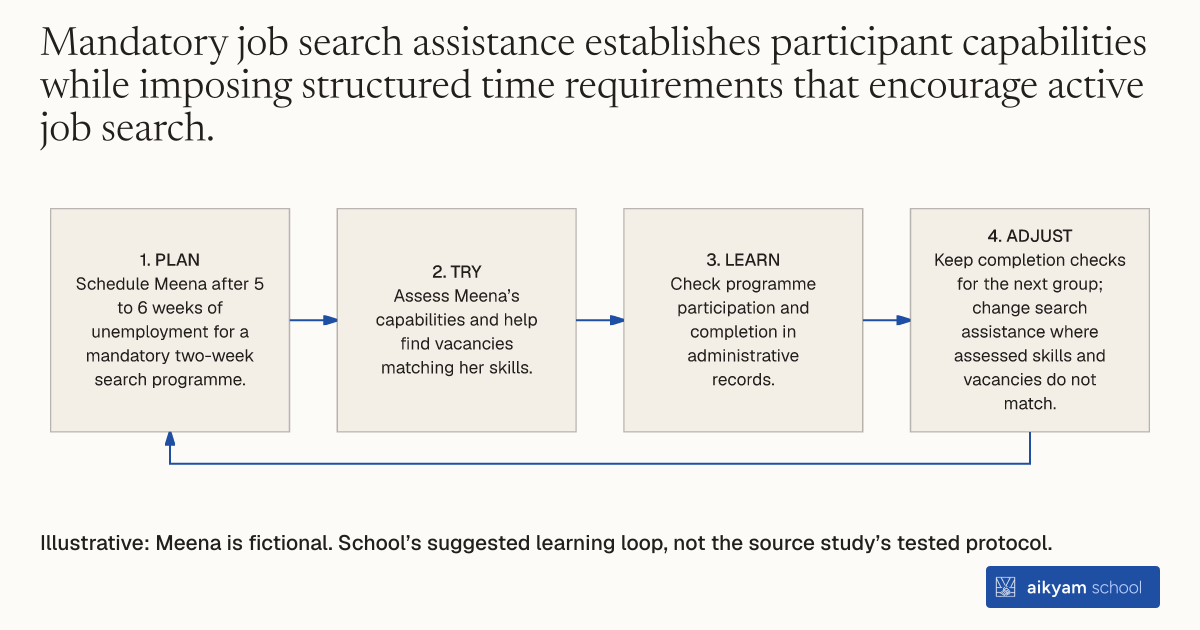
Try, learn and adjust
Check early job search course completion
- Plan: Schedule Meena after 5 to 6 weeks of unemployment for a mandatory two-week search programme.
- Try: Assess Meena’s capabilities and help find vacancies matching her skills.
- Learn: Check programme participation and completion in administrative records.
- Adjust: Keep completion checks for the next group; change search assistance where assessed skills and vacancies do not match.
Illustrative: Meena is fictional. School’s suggested learning loop, not the source study’s tested protocol.
See source →School’s suggested, untested loop. Observe participation, completion and vacancy matching; course attendance did not show a positive direct job-finding effect while in progress.
How
When to use
Newly unemployed workers often lack effective job search techniques or clear knowledge of their workforce capabilities. Mandatory job search assistance courses address this gap by assessing worker skills and guiding job search activities. Public employment agencies use this program for insured individuals early in their unemployment spell.
Enroll newly registered unemployed workers in an intensive job search assistance program early in their unemployment spell.
- Public employment case workers schedule newly registered unemployed workers after 5 to 6 weeks of open unemployment.
- Unemployed participants attend a mandatory two-week job search assistance program.
- Program instructors evaluate the individual work capabilities and skills of each participant.
- Program staff assist participants in searching for specific job vacancies that match their verified skills.
- Case workers log program participation and track completion in administrative databases.
Example
Employment offices in Storstrøm and Southern Jutland assigned unemployed benefit recipients to a two-week program after 5 to 6 weeks of unemployment. In Storstrøm, 84% of treatment workers entered the program within 12 weeks compared to 31% of control workers, whereas attendance peaked at 63% in Southern Jutland.
About the study
Participants
N = 4,513 unemployed individuals across Storstrøm and Southern Jutland counties, Denmark.
Study Design
Randomized controlled trial assigning workers by birth date (1st–15th = treatment, 16th–31st = control) evaluated via parametric duration models.
Results
Participation in job search assistance exhibited no positive direct impact on the job-finding exit rate (coefficients of -0.02 to -0.10 in Storstrøm and -0.66 in Southern Jutland) while in progress, demonstrating that overall regime exit gains were driven by threat effects rather than course attendance.