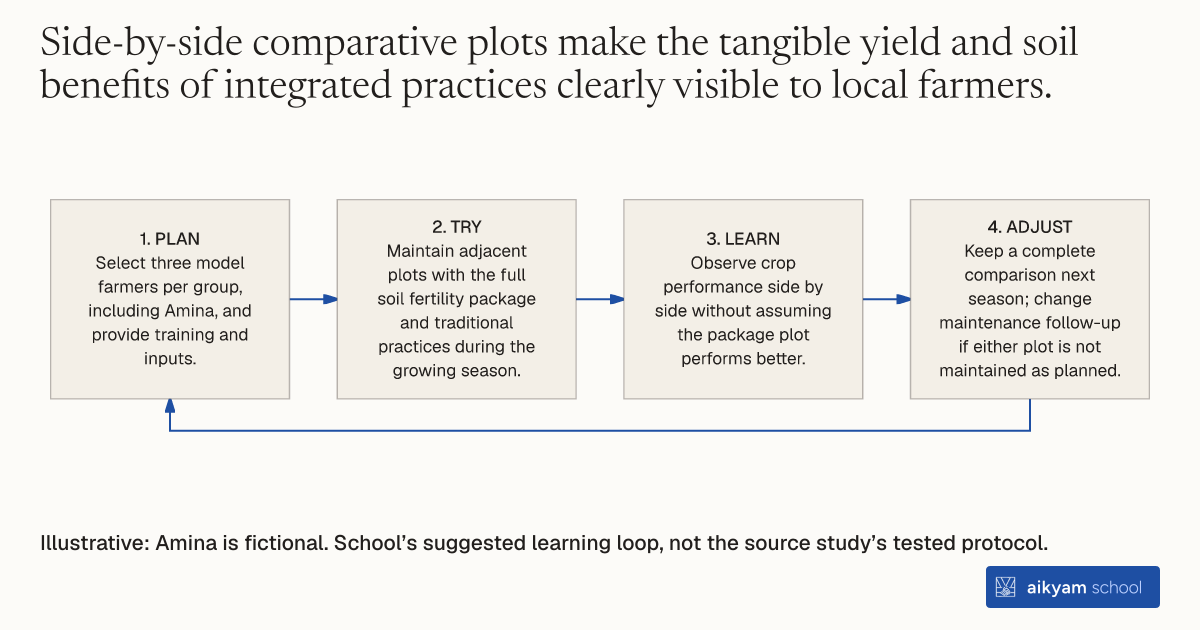
Try, learn and adjust
Compare demonstration plots through the season
- Plan: Select three model farmers per group, including Amina, and provide training and inputs.
- Try: Maintain adjacent plots with the full soil fertility package and traditional practices during the growing season.
- Learn: Observe crop performance side by side without assuming the package plot performs better.
- Adjust: Keep a complete comparison next season; change maintenance follow-up if either plot is not maintained as planned.
Illustrative: Amina is fictional. School’s suggested learning loop, not the source study’s tested protocol.
See source →Observe both plots and practices. Supported model-farmer plots are distinct from community farmers without free inputs. School suggests this learning loop; it was not tested by the source.
How
When to use
Smallholder farmers in developing nations often hesitate to adopt complex agricultural packages because yield gains and management advantages are difficult to observe directly. Traditional classroom instruction fails to provide concrete visual proof of performance. Establishing on-farm trial plots allows farmers to compare improved multi-component systems directly against traditional practices under real local growing conditions.
Establish and maintain on-farm side-by-side demonstration trials to visually showcase improved agricultural technology packages against traditional farming methods.
- Select three model farmers from each farmer research and extension group to lead group activities and manage demonstration plots.
- Train selected model farmers on integrated soil fertility management practices through public agricultural extension agents.
- Supply model farmers with all necessary project inputs, including improved seeds, lime, organic compost, and blended fertilizers.
- Plant side-by-side on-farm plots during the main cropping season, applying the full package on one plot and traditional practices on the adjacent plot.
- Maintain the demonstration fields throughout the growing season to visually highlight productivity differences to neighboring farmers.
Why it works
Seeing live crop performance reduces information uncertainty and builds confidence in complex agricultural packages.
Example
In the GIZ-ISFM+ project across Amhara, Oromia, and Tigray in Ethiopia, 82 active model farmers established on-farm trial plots comparing integrated soil fertility practices with traditional methods during the 2017 main cropping season. Excluding these input-supported model farmers from the analysis, the remaining treatment community farmers still increased their adopted quickwin practice count by 0.390 to 0.526 practices and raised full-package adoption by 7.7 to 10.6 percentage points compared to control communities.
About the study
Participants
N = 82 model farmers and 2,300 community smallholders across 201 microwatersheds in Ethiopia.
Study Design
Cluster Randomized Controlled Trial with re-estimation excluding model farmers to isolate community spillover effects from direct input provision.
Results
Excluding model farmers who received free inputs, assignment to extension alone (T1) increased adopted practices by 0.390 (p < 0.01) and full-package adoption by 7.7 percentage points (p < 0.01); extension plus video (T2) increased practice counts by 0.526 (p < 0.01) and full-package adoption by 10.6 percentage points (p < 0.01) above the control group mean.