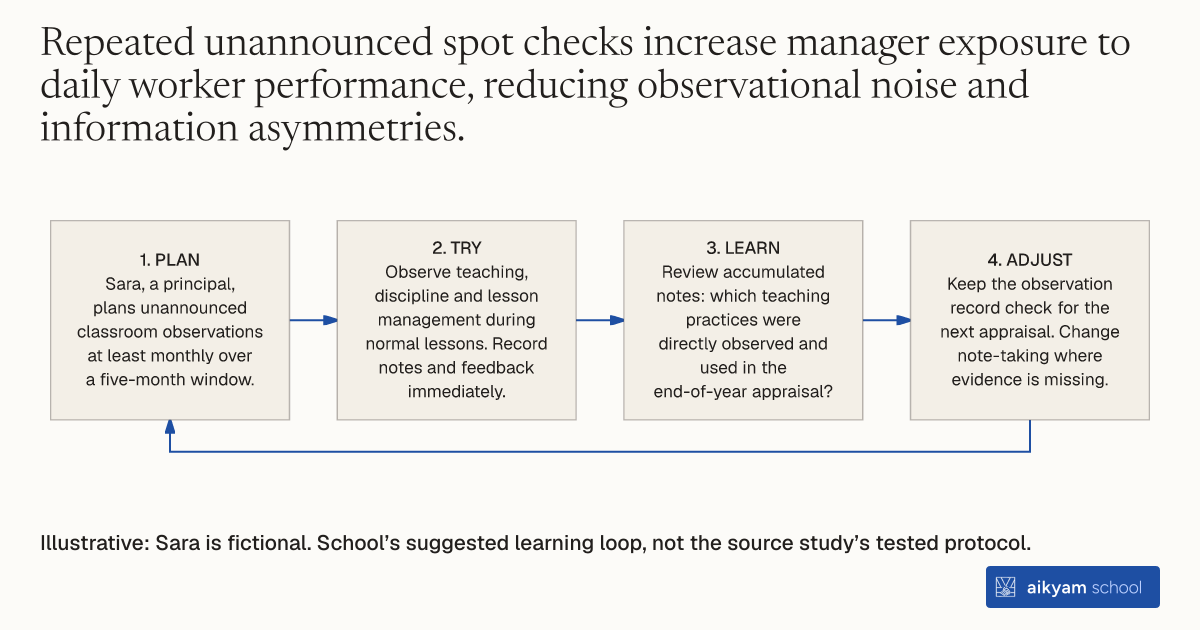
Try, learn and adjust
Check classroom observations inform appraisals
- Plan: Sara, a principal, plans unannounced classroom observations at least monthly over a five-month window.
- Try: Observe teaching, discipline and lesson management during normal lessons. Record notes and feedback immediately.
- Learn: Review accumulated notes: which teaching practices were directly observed and used in the end-of-year appraisal?
- Adjust: Keep the observation record check for the next appraisal. Change note-taking where evidence is missing.
Illustrative: Sara is fictional. School’s suggested learning loop, not the source study’s tested protocol.
See source →School's suggested, untested loop: observe observation frequency, notes and appraisal evidence; this loop does not establish rating accuracy.
How
When to use
Managers often struggle to evaluate employee quality in complex professions where output is subtle or difficult to observe. Standard subjective appraisals become noisy and inaccurate without direct, ongoing exposure to worker practices. This method provides school principals with structured, repeated exposure to actual classroom practice to improve manager evaluation accuracy.
Increase the frequency of unannounced manager spot-check observations to improve appraisal accuracy.
- Assign principals to conduct unannounced classroom observations of targeted teachers at least once a month over a five-month observation window.
- Require principals to enter classrooms unannounced during normal instructional hours without prior scheduling.
- Observe live classroom instruction, focusing on observable teaching practices, student discipline, and lesson management.
- Record observation notes and feedback immediately following each spot check.
- Use accumulated spot-check observation data to inform end-of-year subjective performance appraisals and rankings.
Why it works
Direct observation helps managers observe both high performance and poor practices more clearly, recalibrating ratings toward true productivity.
Example
A private school network in Pakistan randomly assigned teachers to receive frequent unannounced principal spot checks between September 2018 and January 2019. Treated teachers received an average of 2.7 observations compared to 1.8 for control teachers. Principal evaluation accuracy increased significantly, with the correlation coefficient between principal ratings and true teacher outcomes rising from 0.06 in the control group to 0.25 in the treated group.
About the study
Participants
594 teacher-level observation evaluations across participating private schools in Pakistan; teachers averaged 35 years of age and 81 percent were female.
Study Design
Randomized controlled trial conducted within a private school system from September 2018 to January 2019, randomizing teachers to receive frequent unannounced principal spot-check observations versus standard observation schedules.
Results
Assigned spot checks increased principal observation frequency from 1.8 to 2.7 visits and increased the correlation between principal ratings and actual teacher outcomes from 0.06 SD in control to 0.25 SD in treatment (interaction coefficient 0.195 SD, p-value < 0.10).