Research procedure
Give performance feedback before contract choice
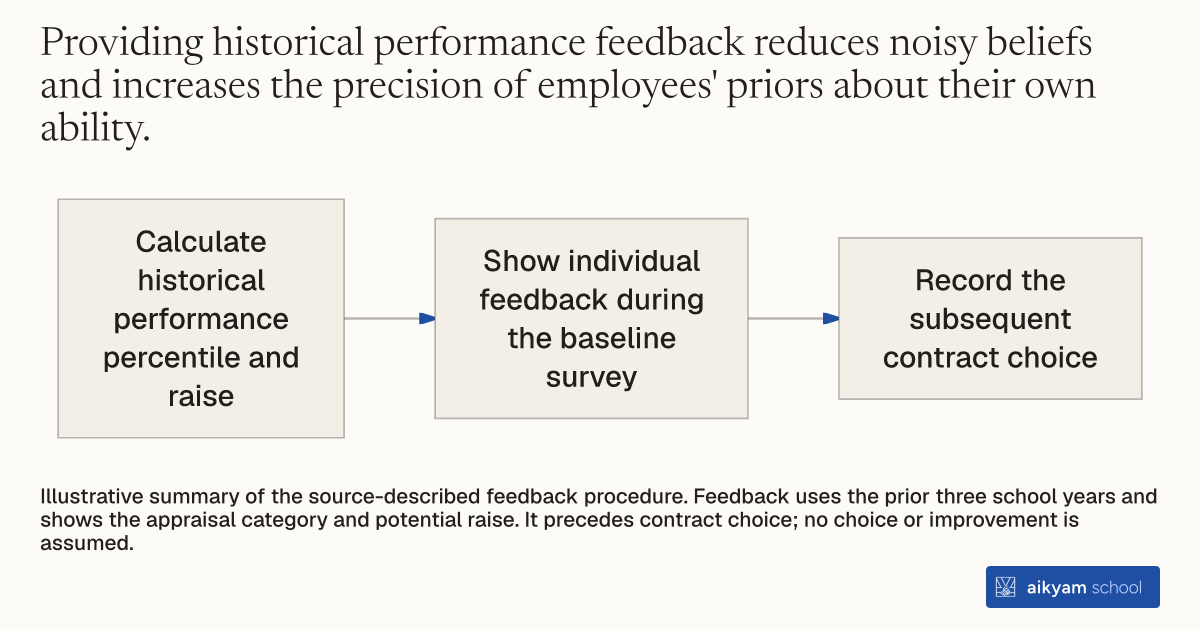
- Calculate historical performance percentile and raise
- Show individual feedback during the baseline survey
- Record the subsequent contract choice
Illustrative summary of the source-described feedback procedure. Feedback uses the prior three school years and shows the appraisal category and potential raise. It precedes contract choice; no choice or improvement is assumed.
See source →How
When to use
Employees often lack accurate information about their own underlying productivity rank or potential performance pay earnings. This method provides objective performance feedback to workers before they make contract or job choices. It helps organizations sharpen employee expectations and strengthen self-selection into incentive structures.
Provide individual employees with historical performance benchmark feedback before contract selection sessions to calibrate their expectations.
- Calculate individual value-added percentile rankings using standardized test scores from the prior three school years.
- Determine corresponding performance appraisal categories and projected raise percentages under variable incentive schedules.
- Deliver a personalized text and numerical feedback prompt to employees during baseline survey administration prior to contract choice.
- Inform employees of their exact historical percentile rank relative to all system peers.
- Display the specific performance appraisal category and potential salary raise they would have received under performance pay rules.
Why it works
Sharper self-knowledge prompts high-performing workers to opt into incentive pay while encouraging low-performing workers to select flat pay contracts.
Example
In a baseline survey of private school teachers across Pakistan, a random subset received historical value-added percentile feedback before choosing contract options. Providing performance information increased the correlation between baseline teacher value-added and choosing performance pay by 50 percent, raising the value-added percentile gap between those selecting performance pay versus flat pay from 6.8 percentiles to 9.8 percentiles.
About the study
Participants
2,020 private school teachers across 326 school clusters in Pakistan participating in baseline survey information trials; sample teachers averaged 38.8 years of age and 6.9 years of experience.
Study Design
Randomized survey-based information experiment conducted during the October 2017 baseline choice exercise comparing teachers provided prior year value-added feedback against an un-informed control group.
Results
Value-added information provision increased the positive sorting gap in percentile rank between teachers choosing performance pay versus flat pay from 6.8 percentiles in control to 9.8 percentiles in treatment, representing a statistically significant 2.95 percentile point increase (p-value < 0.10).