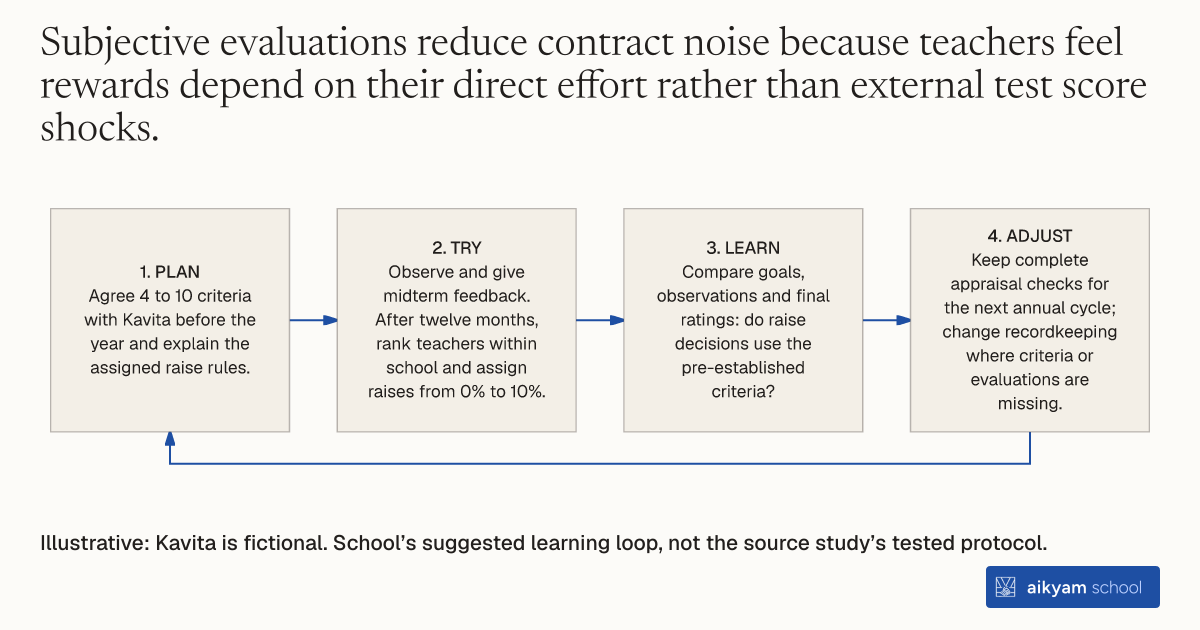
Try, learn and adjust
Check raises follow agreed performance criteria
- Plan: Agree 4 to 10 criteria with Kavita before the year and explain the assigned raise rules.
- Try: Observe and give midterm feedback. After twelve months, rank teachers within school and assign raises from 0% to 10%.
- Learn: Compare goals, observations and final ratings: do raise decisions use the pre-established criteria?
- Adjust: Keep complete appraisal checks for the next annual cycle; change recordkeeping where criteria or evaluations are missing.
Illustrative: Kavita is fictional. School’s suggested learning loop, not the source study’s tested protocol.
See source →School’s suggested, untested learning loop. Observe criteria, feedback, ratings and raises; this loop is separate from the tested compensation contract.
How
When to use
School systems face difficulty motivating teachers when student exam scores fail to capture well-rounded educational effort. Objective test-score incentives often cause narrow test preparation, negative classroom climate, and reduced student socio-emotional growth. Discretionary raises allow managers to evaluate multidimensional performance without forcing teachers to sacrifice non-tested learning goals.
Reward teachers with annual salary raises based on a manager's subjective evaluation of multidimensional performance criteria set at the beginning of the year.
- Establish four to ten specific performance criteria per teacher prior to the academic year, covering pedagogy, classroom behavior management, and administrative tasks.
- Present the raise contract rules to managers and teachers once per term through human resources presentations and portal communications.
- Conduct regular classroom observations during the school year, spending about one third of manager work hours on staff observation and feedback.
- Send teachers midterm performance updates halfway through the year to communicate progress and expected raise standings.
- Evaluate teacher effort and performance across the pre-established criteria at the end of the twelve-month review cycle.
- Rank teachers within each school into percentile tiers and assign annual salary raises ranging from 0% to 10% based on their tournament rank.
Why it works
Discretionary evaluation also lowers distortion by rewarding holistic teaching practices that foster both academic learning and student socio-emotional development.
Example
A private school system in Pakistan implemented manager-discretionary raises from 0% to 10% for core teachers across 234 schools over a twelve-month review cycle. Teachers under subjective raises improved student test scores by 0.086 standard deviations while increasing attendance by nearly 6 days per year and preserving positive classroom climate.
About the study
Participants
6,080 teachers (80% female), 189 managers, and 141,566 student-subject test observations across 234 private schools in Pakistan (grades 4–13).
Study Design
Randomized controlled trial (RCT) comparing flat 5% raises, manager-discretionary subjective performance raises (0–10%), and test-score percentile value-added objective raises (0–10%) in within-school tournaments over an 18-month intervention.
Results
Subjective performance raises increased student test scores by 0.0859 standard deviations (p = 0.022), increased teacher attendance by 5.927 days per year (p = 0.0719), and achieved a 0.05 standard deviation higher student socio-emotional score compared to objective incentives.