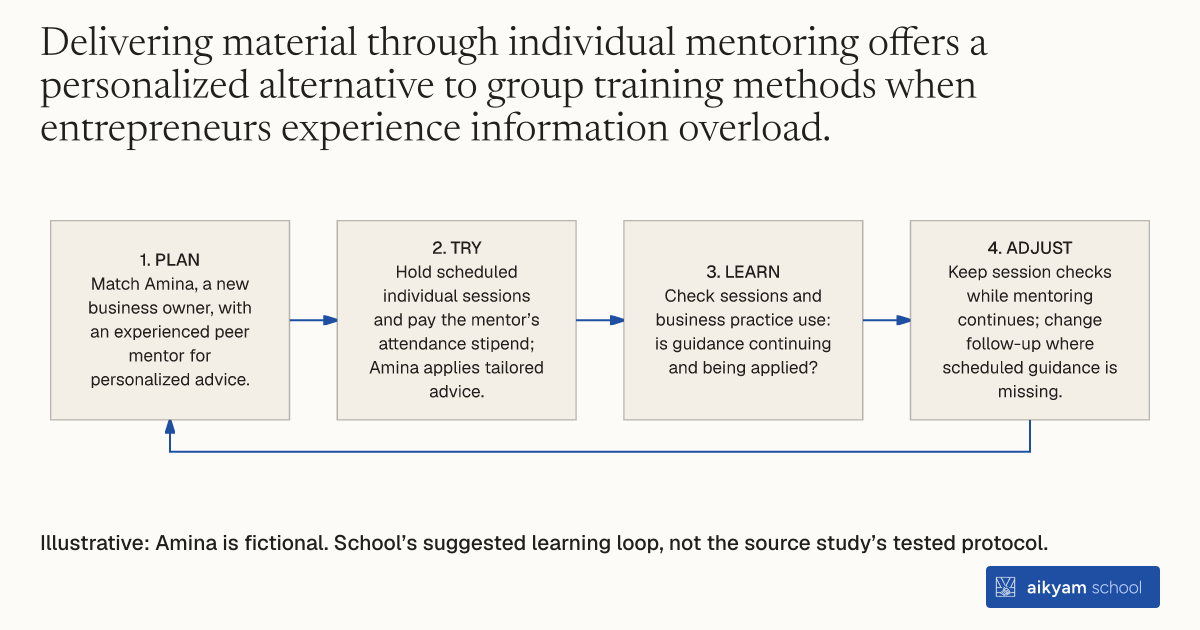
Try, learn and adjust
Check one-to-one mentoring continues
- Plan: Match Amina, a new business owner, with an experienced peer mentor for personalized advice.
- Try: Hold scheduled individual sessions and pay the mentor’s attendance stipend; Amina applies tailored advice.
- Learn: Check sessions and business practice use: is guidance continuing and being applied?
- Adjust: Keep session checks while mentoring continues; change follow-up where scheduled guidance is missing.
Illustrative: Amina is fictional. School’s suggested learning loop, not the source study’s tested protocol.
See source →School’s suggested, untested learning loop. Observe sessions, mentor payments and practice use; Kenyan profit effects faded after payments ended, with no lasting effect established.
How
When to use
Microentrepreneurs facing information overload from classroom-based trainings may benefit from personalized instruction. One-on-one mentoring provides individual guidance to address specific business needs. This method pairs entrepreneurs with experienced peers to deliver customized business advice.
Pair new microentrepreneurs with experienced peer mentors to deliver personalized business guidance during one-on-one sessions.
- Program administrators identify new microentrepreneurs facing operational challenges or information overload from group training.
- Program coordinators match participants individually with experienced peer mentors.
- Mentors attend one-on-one meetings with mentees to provide tailored advice and feedback.
- Program sponsors pay mentors a stipend for attending scheduled one-on-one sessions.
- Microentrepreneurs implement personalized guidance into daily firm operations.
Why it works
Mentors provide direct, tailored advice to help business owners address specific operational challenges.
Example
In Kenya, new women entrepreneurs worked with mentors in one-on-one sessions, increasing their profits by 20 percent before effects faded after mentor payments ended.
About the study
Participants
New female entrepreneurs and microenterprise owners evaluated across three studies in Kenya and Ethiopia.
Study Design
Randomized controlled trials evaluating one-on-one mentoring programs against control groups over short- and long-term horizons.
Results
New women entrepreneurs in Kenya who worked with mentors increased profits by 20 percent, but these effects faded after one year as mentors stopped receiving payments; two other mentoring programs in Kenya and Ethiopia had no long-term impact on firm performance.