Try, learn and adjust
Check familiarity within a peer group
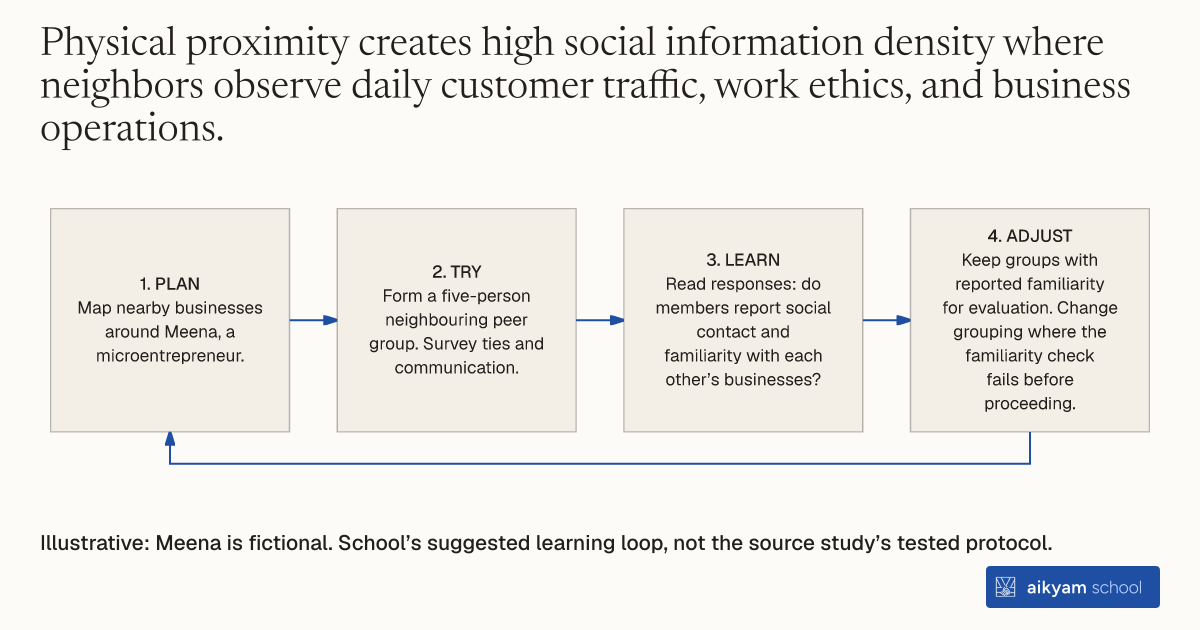
- Plan: Map nearby businesses around Meena, a microentrepreneur.
- Try: Form a five-person neighbouring peer group. Survey ties and communication.
- Learn: Read responses: do members report social contact and familiarity with each other’s businesses?
- Adjust: Keep groups with reported familiarity for evaluation. Change grouping where the familiarity check fails before proceeding.
Illustrative: Meena is fictional. School’s suggested learning loop, not the source study’s tested protocol.
See source →School’s suggested, untested loop. Observe proximity, social ties and business familiarity; these checks do not establish lending returns.
How
When to use
Organizers and microfinance providers need to capture local intelligence about informal business operators who lack accounting records. Outside inspectors cannot easily observe daily business performance or personal character. Clustering nearby business owners into small peer groups unlocks dense social networks where neighbors already observe each other daily.
Group neighboring microentrepreneurs into five-person peer clusters based on physical proximity to capture local social information.
- Map local commercial areas across target peri-urban neighborhoods.
- Identify clusters of five nearby microentrepreneurs operating within close physical proximity.
- Form peer groups consisting of five neighboring business owners.
- Survey group members to record social connections, kinship ties, and communication frequency.
- Verify that group members share sufficient social interaction and business familiarity before conducting evaluations.
Why it works
Pre-existing social and business interactions allow group members to evaluate underlying entrepreneurial ability without formal accounting records.
Example
Researchers organized 1,345 households into 274 peer groups of five neighboring microentrepreneurs in Amravati, Maharashtra, India. Two-thirds of participants identified at least one group member as family or a close friend. Over half of the participants reported regularly discussing private family and business matters with members of their five-person group.
About the study
Participants
1,345 households across nine peri-urban neighborhoods organized into 274 peer groups of five in Amravati, Maharashtra, India.
Study Design
Sociometric mapping and baseline peer clustering based on geographical proximity within peri-urban communities.
Results
Two-thirds (66 percent) of respondents identified at least one group member as a family member or close friend, and over 50 percent reported regularly discussing private family and business matters with a group member.