Research procedure
Sample nearby households for spillover analysis
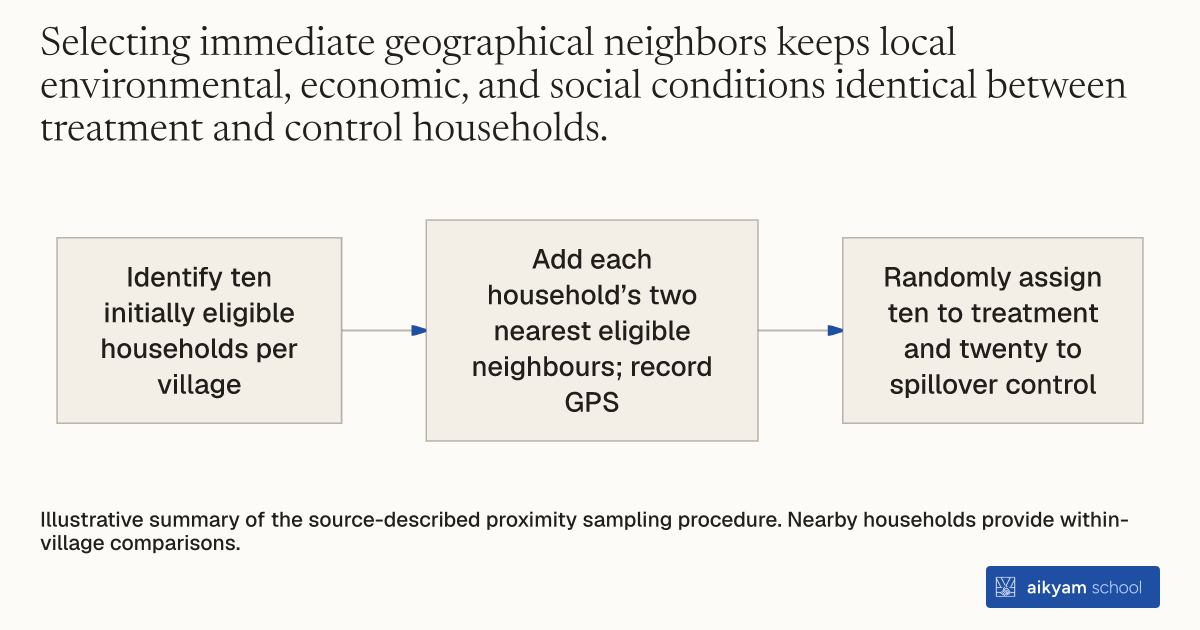
- Identify ten initially eligible households per village
- Add each household’s two nearest eligible neighbours; record GPS
- Randomly assign ten to treatment and twenty to spillover control
Illustrative summary of the source-described proximity sampling procedure. Nearby households provide within-village comparisons.
See source →How
When to use
Field trials often need to measure local spillover effects and compare treated households against nearby neighbors within the same community. Simple random sampling across a wide village can scatter comparison households far from treated ones, making spatial comparison difficult. This method selects comparison households based on physical distance to ensure close geographic alignment between treated and non-treated participants.
Select within-village comparison households by identifying the two dwellings geographically closest to each initially selected household.
- Field officers visit target villages and identify ten initial eligible households using structural targeting criteria.
- Field officers locate the physical dwelling of each initial household during baseline field visits.
- Field officers identify the two eligible neighboring households that are geographically closest to each initial household.
- Field officers recruit and survey one respondent from each selected neighboring household to expand the village sample to thirty households.
- Field officers record precise GPS coordinates for every surveyed dwelling to verify household locations.
- Survey coordinators randomly assign one-third of the village sample to treatment and two-thirds to spillover control status.
Why it works
This spatial closeness allows researchers to test for localized spillover effects within the same village context.
Example
In rural Nakuru County, Kenya, field officers selected ten initial households per village and then sampled the two nearest eligible neighbors for each, recruiting 30 households per village across 180 villages. Researchers then assigned one-third to treatment and two-thirds to within-village spillover control status.
About the study
Participants
5,756 low-income individuals across 233 rural villages in Nakuru County, Kenya, including 1,237 cash spillover households and 1,219 PM+ spillover households.
Study Design
A randomized controlled trial using a two-stage randomization where villages were assigned to treatment or control, and households within cash and psychotherapy villages were randomized into treatment (10 households) or within-village spillover control (20 households) based on geographic proximity sampling.
Results
Non-recipient spillover households in cash villages showed small, statistically insignificant increases of 7 percent in consumption (USD 3.46 PPP) and 3 percent in assets (USD 13.89 PPP) relative to pure control villages, indicating minimal economic spillovers.