Research steps
Phase rollout across places and time
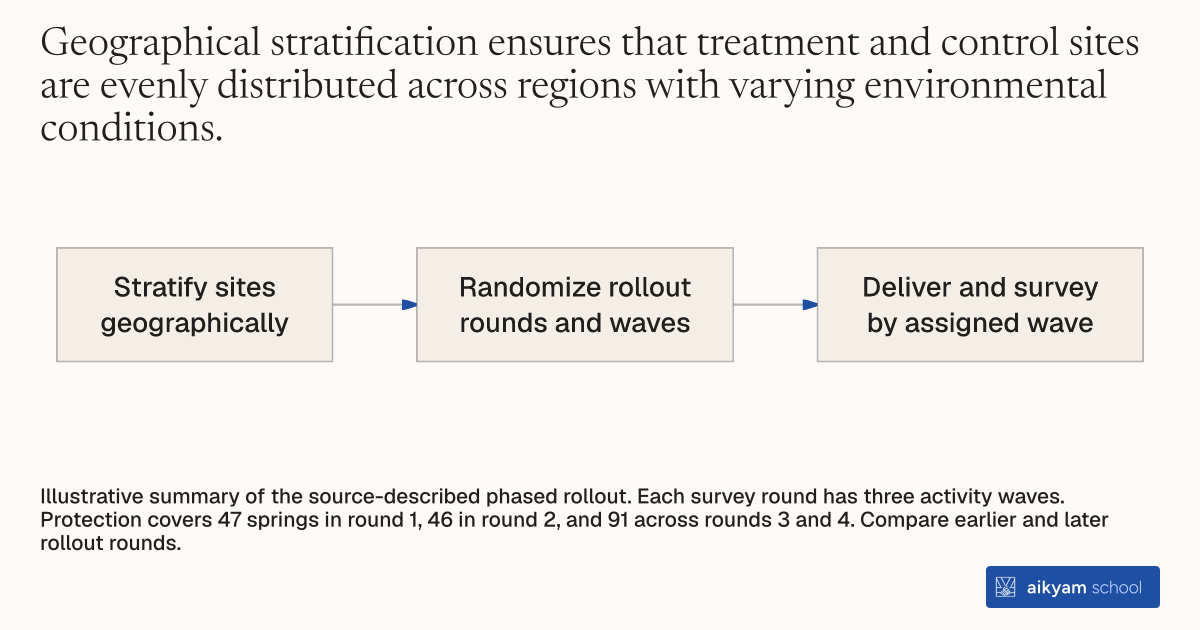
- Stratify sites geographically
- Randomize rollout rounds and waves
- Deliver and survey by assigned wave
Illustrative summary of the source-described phased rollout. Each survey round has three activity waves. Protection covers 47 springs in round 1, 46 in round 2, and 91 across rounds 3 and 4. Compare earlier and later rollout rounds.
See source →How
When to use
In large-scale field interventions, financial and administrative constraints often prevent simultaneous execution across all target sites. Rollout over time can introduce confounding seasonal or location biases in evaluations. Stratifying sites geographically into randomized waves balances implementation workloads while maintaining rigorous experimental comparison groups.
Structure a multi-year program rollout using geographical stratification and randomized wave scheduling to balance administrative capacity and control for seasonal effects.
- Program managers divide the eligible study sites into distinct geographical clusters based on administrative boundaries.
- Managers randomly assign sites within each geographical stratum into phased rollout rounds across project years.
- Survey managers divide each survey round into three separate activity waves to ensure representative temporal sampling throughout the year.
- Field teams conduct project activities and data collection sequentially according to assigned wave groupings.
- Researchers compare early treatment rounds against later rollout rounds as comparison groups to measure program impacts.
Why it works
Dividing survey rounds into distinct temporal waves controls for seasonal fluctuations in water quality and disease prevalence across treatment and comparison groups.
Example
In Busia and Butere-Mumias districts of western Kenya, International Child Support phased spring protection over four years, protecting 47 springs in round 1, 46 in round 2, and 91 in rounds 3 and 4 across randomized survey waves.
About the study
Participants
184 viable springs and 1,354 households across Busia and Butere-Mumias districts in Western Province, Kenya.
Study Design
Four-year panel data collection (2004–2007) with geographical stratification and division of each survey round into three randomized activity waves.
Results
Attrition remained modest at 5% for at least two follow-up rounds, with no statistically significant difference in attrition between treatment and comparison groups (coefficient 0.012, standard error 0.018).