Research procedure
Compare early and delayed land reform
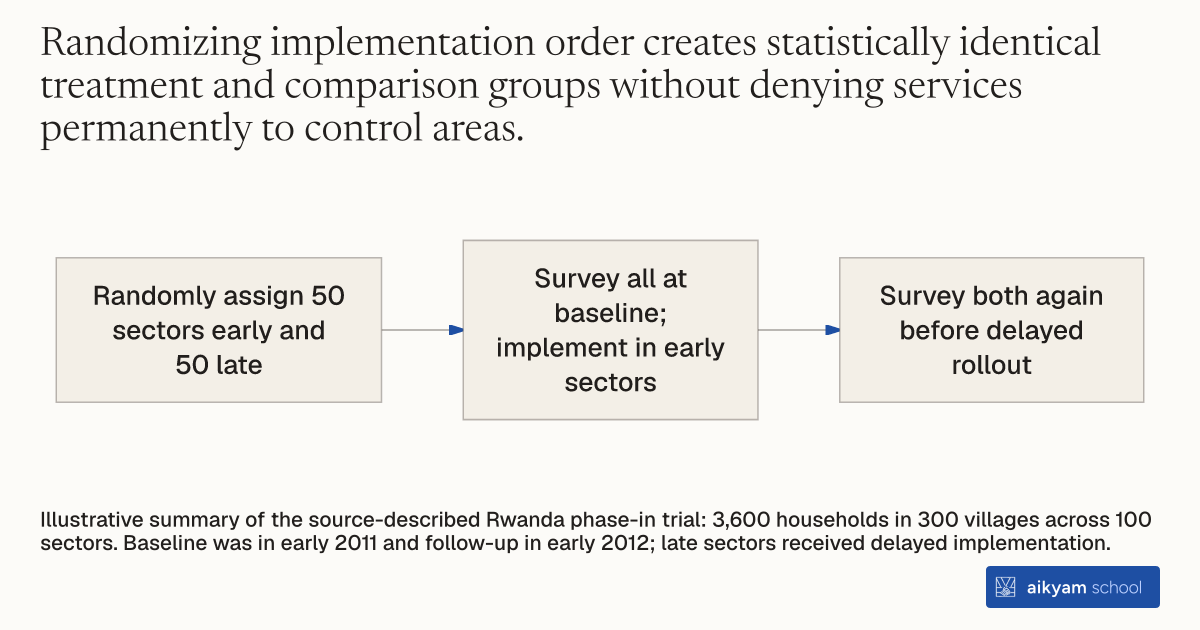
- Randomly assign 50 sectors early and 50 late
- Survey all at baseline; implement in early sectors
- Survey both again before delayed rollout
Illustrative summary of the source-described Rwanda phase-in trial: 3,600 households in 300 villages across 100 sectors. Baseline was in early 2011 and follow-up in early 2012; late sectors received delayed implementation.
See source →How
When to use
Governments introducing national reforms need to evaluate impacts rigorously without withholding benefits permanently from comparison groups. Evaluators randomize the timeline of implementation across administrative units to create valid control groups. This design allows researchers to measure short-term outcomes while ensuring universal rollout.
Randomize the timing of program rollout across geographic clusters to evaluate short-term impacts against delayed control units.
- Evaluators select eligible administrative sectors nationwide to participate in the evaluation.
- Researchers randomly assign half of the selected sectors to an early treatment group and half to a late control group.
- Survey teams collect baseline data at household, individual, and parcel levels across all target sectors before implementation begins.
- Program staff execute full program adjudication and demarcation immediately in early treatment sectors.
- Survey teams conduct follow-up surveys in both early and late sectors to measure short-term program impacts before control sector rollout.
Example
World Bank and local researchers randomly selected 100 eligible sectors in Rwanda, assigning 50 to an early implementation group and 50 to a late group, surveying 3,600 households across 300 villages.
About the study
Participants
3,600 households drawn from 300 villages in 100 eligible sectors across rural Rwanda.
Study Design
Cluster-randomized trial assigning 50 sectors to early implementation and 50 sectors to late implementation, with baseline data collected in early 2011 and follow-up in early 2012.
Results
The design enabled researchers to isolate early program impacts, finding a 4 to 5 percentage point reduction in land disagreements and a 19 to 34 percentage point increase in married women registered as land claimants.