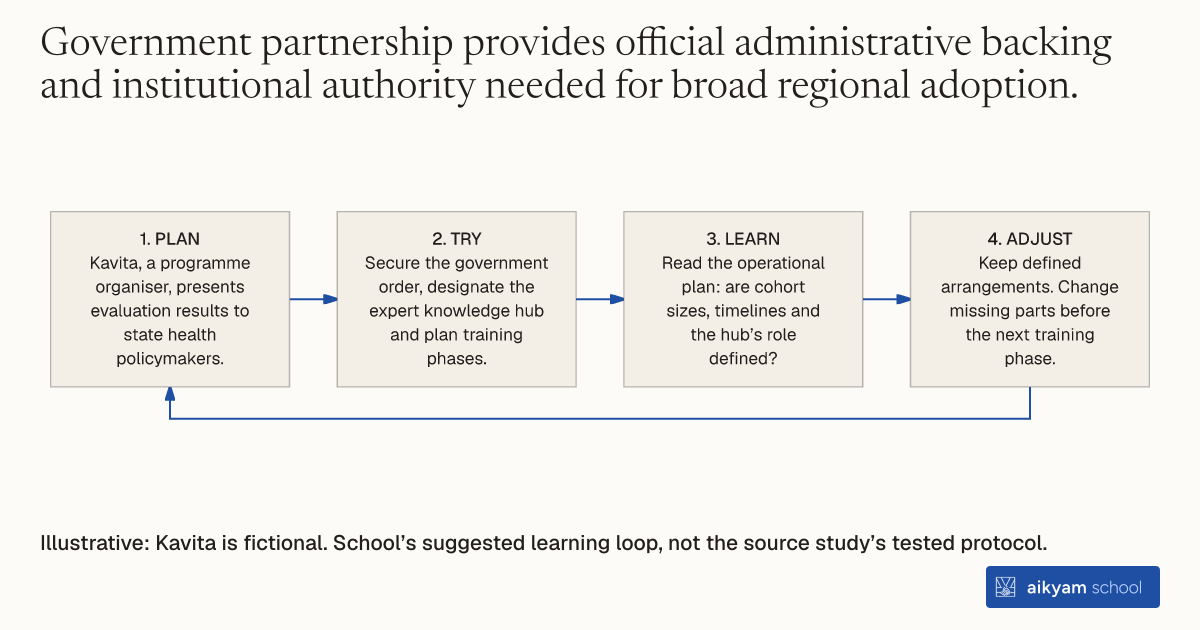
Try, learn and adjust
Check plans for statewide provider training
- Plan: Kavita, a programme organiser, presents evaluation results to state health policymakers.
- Try: Secure the government order, designate the expert knowledge hub and plan training phases.
- Learn: Read the operational plan: are cohort sizes, timelines and the hub’s role defined?
- Adjust: Keep defined arrangements. Change missing parts before the next training phase.
Illustrative: Kavita is fictional. School’s suggested learning loop, not the source study’s tested protocol.
See source →School’s suggested learning loop: observe government authorisation and training plans; the initial expansion targeted 2,000 practitioners over six months.
How
When to use
In many developing countries, pilot health programs succeed in small evaluations but fail to reach population scale without public health integration. Policy makers and non-governmental organizations need a mechanism to translate rigorous evidence into state-wide public policy. This method scales tested health interventions across an entire state through formal government policy and non-profit technical partnership.
Partner with state government authorities to scale a tested training program for informal healthcare providers using an expert non-governmental organization as a resource hub.
- Present rigorous evaluation results on informal provider training to state health policymakers.
- Secure an official government order authorizing the state-wide expansion of the training initiative.
- Designate an experienced non-profit partner to act as the central resource and knowledge hub.
- Establish operational plans and timelines to train large cohorts of informal health practitioners.
- Execute the state-wide training program in six-month phases targeting thousands of local practitioners.
Why it works
Partnering with an expert non-governmental organization as a knowledge hub ensures training quality remains high during rapid expansion.
Example
In West Bengal, India, evaluation findings led the state government to issue an order in 2016 establishing a state-wide training program for informal practitioners. The government designated the Liver Foundation as a knowledge hub to train an initial cohort of 2,000 practitioners over six months in 2017.
About the study
Participants
304 informal healthcare providers across 203 communities in the randomized trial; initial scale-up cohort of 2,000 practitioners state-wide in West Bengal, India.
Study Design
Randomized evaluation evaluating quality improvements across 304 informal providers to inform a state-wide government policy order.
Results
Evidence from the evaluation led the Government of West Bengal to issue a 2016 policy order launching a state-wide expansion targeting an initial batch of 2,000 practitioners.