Try, learn and adjust
Check repayment support in the borrower group
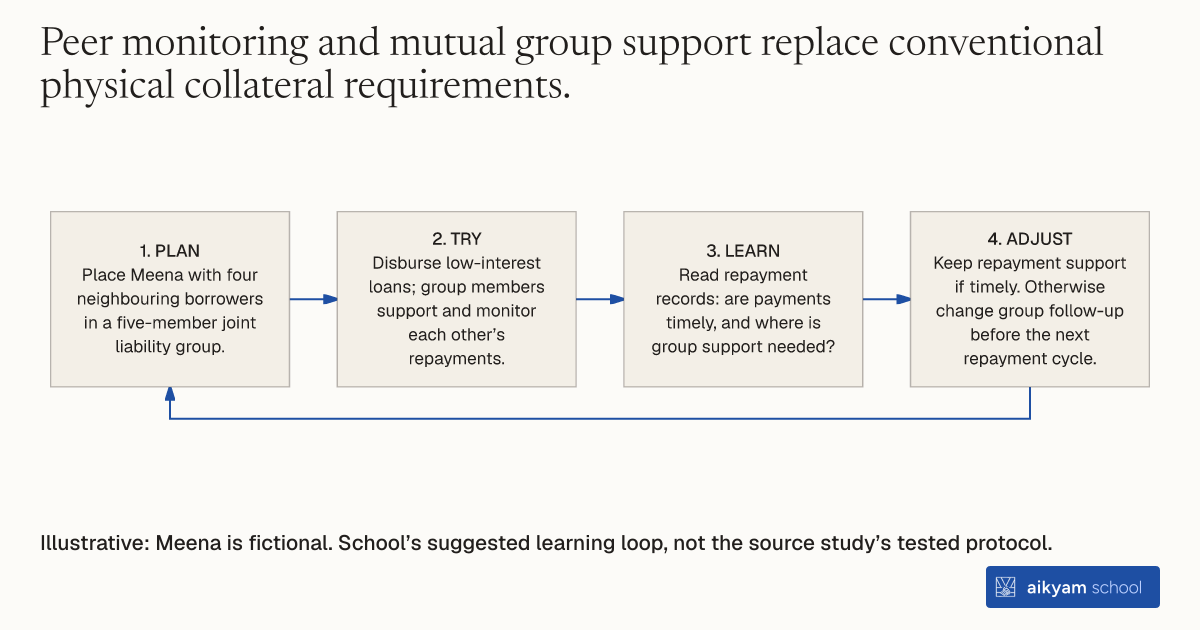
- Plan: Place Meena with four neighbouring borrowers in a five-member joint liability group.
- Try: Disburse low-interest loans; group members support and monitor each other’s repayments.
- Learn: Read repayment records: are payments timely, and where is group support needed?
- Adjust: Keep repayment support if timely. Otherwise change group follow-up before the next repayment cycle.
Illustrative: Meena is fictional. School’s suggested learning loop, not the source study’s tested protocol.
See source →School’s suggested, untested learning loop. Observe repayment timing and peer support. Technology-adoption impact findings are forthcoming.
How
When to use
Rural farming households in Tamil Nadu lack access to formal credit sources and capital. This shortage prevents smallholder farmers from buying productive agricultural tools like improved seeds or fertilizer. Offering joint liability loans provides affordable financial credit to rural agricultural borrowers without traditional bank collateral.
Form joint liability borrower groups through local rural financial branches to deliver low-interest agricultural loans.
- Financial institutions establish branch offices in rural village locations across Tamil Nadu.
- Field staff group five neighboring rural borrowers together into a joint liability unit.
- Financial institutions disburse microfinance loans at low interest rates to group members.
- Five group members support and monitor each other to ensure timely loan repayments.
Why it works
Low interest rates encourage high program take-up among farming households needing capital for productive agricultural investments.
Example
Pudhuaaru, Vellaaru, and Thenaaru Kshetriya Grameen Financial Services offered joint liability microfinance loans to rural farming households in Thanjavur, Tamil Nadu, expanding credit access in communities where only 27 percent of households had formal credit in 2003.
About the study
Participants
4,500 to 5,500 households served by 100 to 120 planned rural financial service branches in Thanjavur, Tamil Nadu, India.
Study Design
Phased randomized controlled trial comparing households in catchment areas of 50 to 60 early-opening treatment branches against paired delayed-expansion control branch areas over two years.
Results
Formal credit access stood at 27 percent among farming households in 2003, per capita state income was US\$1,271 in 2008, and impact results on technology adoption are listed as forthcoming.