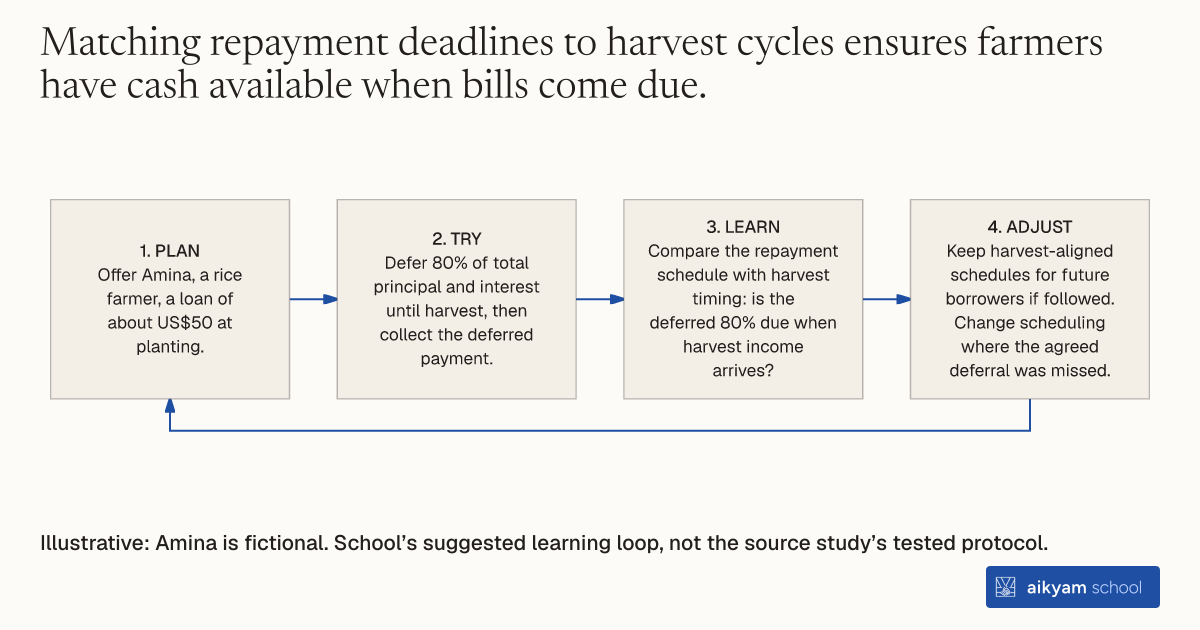
Try, learn and adjust
Check deferred payments align with harvest
- Plan: Offer Amina, a rice farmer, a loan of about US$50 at planting.
- Try: Defer 80% of total principal and interest until harvest, then collect the deferred payment.
- Learn: Compare the repayment schedule with harvest timing: is the deferred 80% due when harvest income arrives?
- Adjust: Keep harvest-aligned schedules for future borrowers if followed. Change scheduling where the agreed deferral was missed.
Illustrative: Amina is fictional. School’s suggested learning loop, not the source study’s tested protocol.
See source →School’s suggested, untested loop. Observe loan terms, harvest timing and repayments; the deferred amount remains repayable debt.
How
When to use
Small-scale farmers earn income once or twice per year at harvest time. Traditional microcredit requires biweekly repayments starting right after disbursement. Deferring repayments until harvest aligns debt collection with agricultural cash flows.
Structure microcredit agreements so farmers repay principal and interest after harvesting crops.
- Financial institutions disburse loans to smallholder farmers at the start of the planting season.
- Lenders defer 80 percent of total principal and interest payments until the harvest period.
- Lenders collect the deferred bulk payment once farmers earn harvest income.
Example
Microfinance lenders offered rice farmers in Tanzania US\$50 loans where 80 percent of the payment was deferred until harvest. About 39 percent of farmers chose to borrow under these terms, and over 92 percent repaid their loans.
About the study
Participants
Smallholder rice farmers in Tanzania.
Study Design
Randomized controlled trial evaluating microcredit take-up under harvest-aligned repayment schedules compared to standard schedules.
Results
Tailoring repayment to harvest increased loan take-up to 39 percent and achieved a 92 percent loan repayment rate.