Try, learn and adjust
Check the transition to microloan eligibility
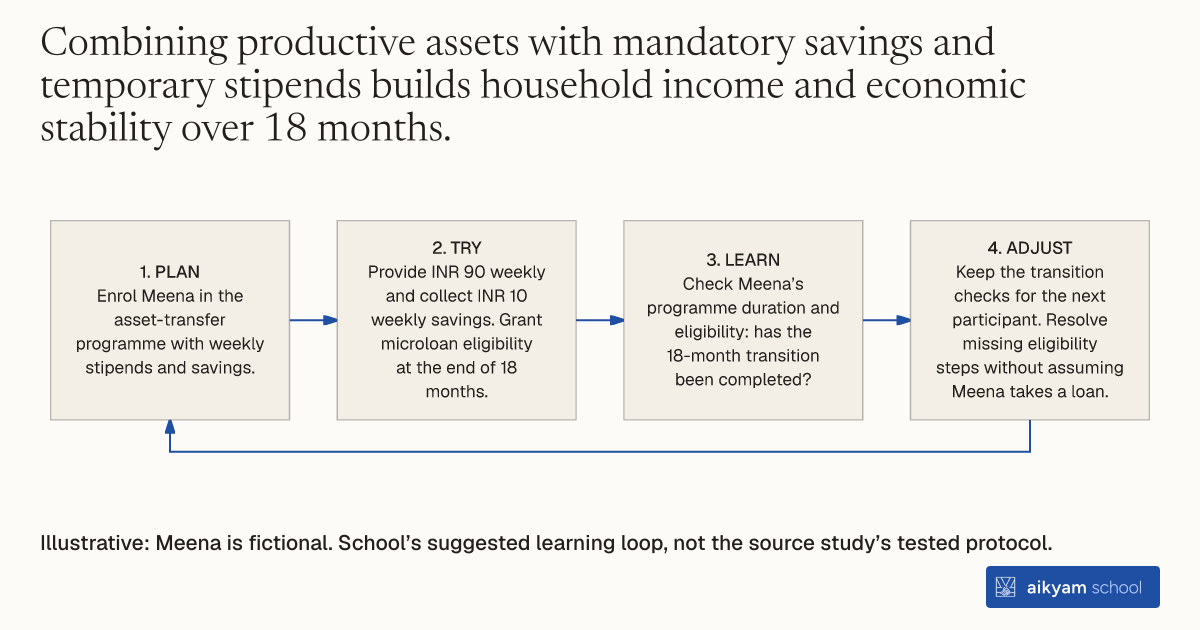
- Plan: Enrol Meena in the asset-transfer programme with weekly stipends and savings.
- Try: Provide INR 90 weekly and collect INR 10 weekly savings. Grant microloan eligibility at the end of 18 months.
- Learn: Check Meena’s programme duration and eligibility: has the 18-month transition been completed?
- Adjust: Keep the transition checks for the next participant. Resolve missing eligibility steps without assuming Meena takes a loan.
Illustrative: Meena is fictional. School’s suggested learning loop, not the source study’s tested protocol.
See source →School’s suggested, untested loop. Observe programme duration and microloan eligibility; eligibility does not mean borrowing.
How
When to use
Ultra-poor households are typically considered ineligible for standard microfinance loans due to a lack of collateral and unstable incomes. After receiving productive assets, cash stipends, and savings support, participants build economic stability over time. This method serves microfinance institutions seeking to transition ultra-poor families into standard microcredit markets.
Grant formal microloan eligibility to ultra-poor households after completing an intensive multi-faceted livelihood program.
- NGO staff in Murshidabad, West Bengal, India select low-income households to receive productive assets and stipends.
- Field officers deliver productive assets and disburse weekly cash stipends of INR 90 (US\$2.25) to participant households.
- Program staff collect mandatory weekly savings of INR 10 (US\$0.25) from participants during weekly meetings.
- Participants manage their productive assets and accumulate savings across the 18-month intervention period.
- NGO managers grant participants eligibility for standard microloans at the end of 18 months.
Why it works
This capacity building enables formerly destitute families to qualify for formal microcredit opportunities.
Example
Bandhan in Murshidabad, West Bengal, India enrolled 429 low-income households in an asset transfer program, providing productive assets and weekly stipends, and made participants eligible for microloans at the end of 18 months.
About the study
Participants
817 low-income households in Murshidabad, West Bengal, India (429 asset transfer group, 388 comparison group).
Study Design
Randomized controlled trial evaluating an 18-month Graduation Approach program with household surveys at baseline in May 2007, 18 months post-transfer, and 30 months post-transfer.
Results
Recipient households consumed 12.8 percent more fuel than comparison households, increased electricity lighting use by 4.7 percentage points, and increased cow dung use by 10.6 percentage points.