Try, learn and adjust
Check lean-season credit and repayment together
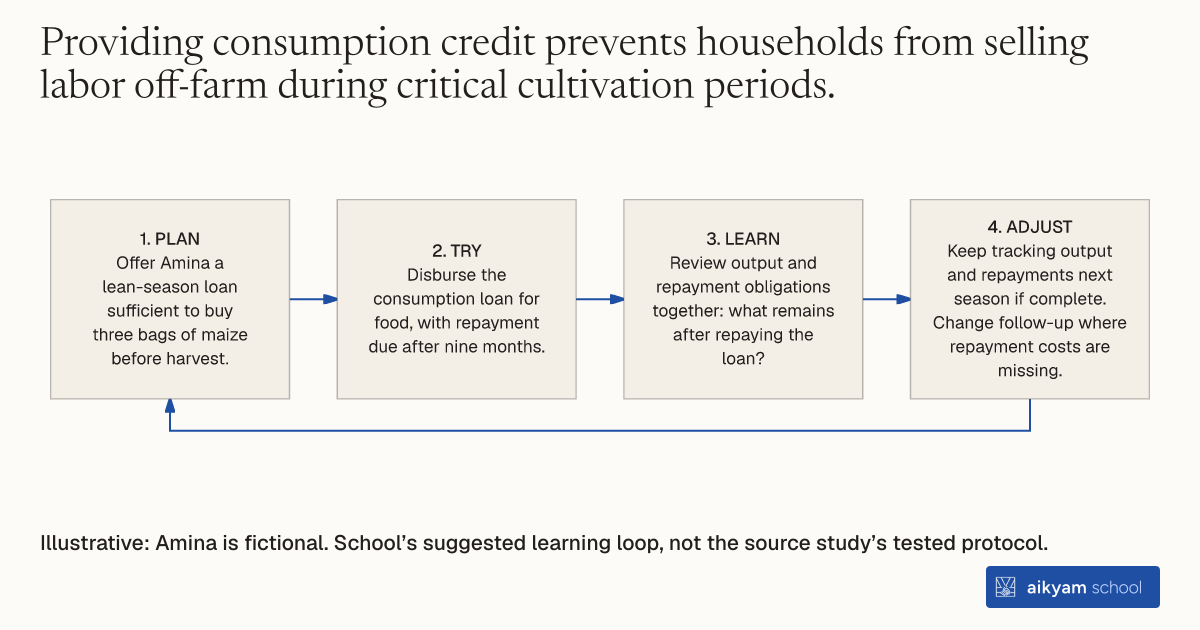
- Plan: Offer Amina a lean-season loan sufficient to buy three bags of maize before harvest.
- Try: Disburse the consumption loan for food, with repayment due after nine months.
- Learn: Review output and repayment obligations together: what remains after repaying the loan?
- Adjust: Keep tracking output and repayments next season if complete. Change follow-up where repayment costs are missing.
Illustrative: Amina is fictional. School’s suggested learning loop, not the source study’s tested protocol.
See source →School’s suggested, untested loop. Observe food credit, output and repayments. The source reports higher output but farmers breaking even after repayment.
How
When to use
Smallholder farmers experience acute liquidity shortages and food insecurity during the lean season before harvest. This forces households to seek off-farm wage labor instead of working on their own crops. Providing small consumption loans during the lean season helps farmers cover food needs until harvest.
Provide small seasonal loans during the pre-harvest lean period to cover household consumption needs.
- Financial institutions identify smallholder farming households experiencing pre-harvest food shortages.
- Lenders disburse small loans calibrated to cover essential food consumption, such as three bags of maize.
- Farmers spend loan proceeds on food consumption during the lean season.
- Lenders collect full loan repayments after a nine-month period following harvest.
Example
Farmers in Zambia were offered a small loan enough to purchase three bags of maize during the lean season before harvest, with repayment due after nine months. Farmers increased their agricultural output by 9 percent, but loan repayments left them breaking even.
About the study
Participants
Smallholder farmers in Zambia.
Study Design
Randomized controlled trial evaluating pre-harvest consumption credit with a nine-month repayment period.
Results
Farmers increased agricultural output by 9 percent, but loan repayments offset gains, leaving farmers breaking even.