Try, learn and adjust
Check road and banking access together
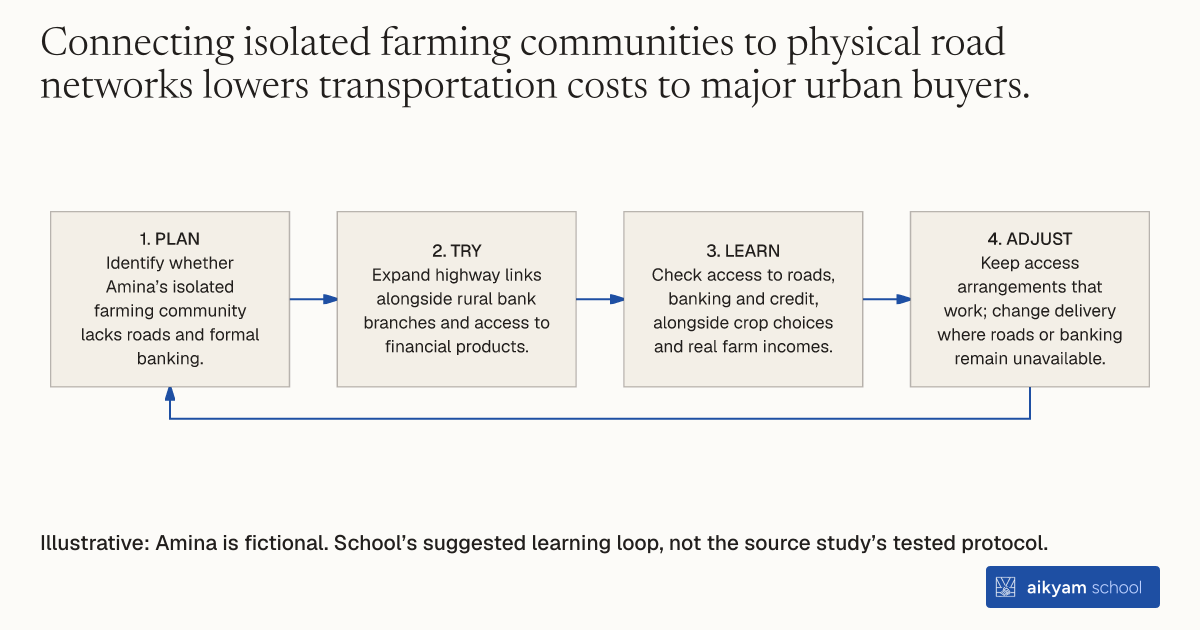
- Plan: Identify whether Amina’s isolated farming community lacks roads and formal banking.
- Try: Expand highway links alongside rural bank branches and access to financial products.
- Learn: Check access to roads, banking and credit, alongside crop choices and real farm incomes.
- Adjust: Keep access arrangements that work; change delivery where roads or banking remain unavailable.
Illustrative: Amina is fictional. School’s suggested learning loop, not the source study’s tested protocol.
See source →Observe both forms of access and farm incomes. The source describes forty years of Indian evidence, not a test of this loop. School suggests this learning loop; it was not tested by the source.
How
When to use
Small-scale farmers in remote rural communities face high physical transport costs and market isolation. Physical isolation depresses agricultural profitability and discourages producers from investing in higher-yield crops. Co-locating highway transport infrastructure with rural financial institutions gives farmers the access and security needed to transition to higher-risk, higher-return commercial agriculture.
Expand highway transport infrastructure into isolated rural farming regions alongside financial branch network expansion.
- Identify isolated rural agricultural communities lacking paved road access and formal banking services.
- Construct or expand highway transportation corridors connecting target rural farming hubs to regional market centers.
- Open rural bank branches and microfinance services within the newly connected farming communities.
- Provide local smallholders with formal credit and financial products to de-risk commercial farming investments.
- Support farmers in transitioning land allocation toward higher-value commercial cash crops.
Why it works
Access to local financial banking services de-risks business operations, allowing farmers to safely invest in higher-risk, higher-return agricultural crops.
Example
In rural India, a study evaluated forty years of highway expansion combined with local financial institution access across farming communities. Transport infrastructure expansion increased real farm incomes, while complementing highway access with rural bank branches achieved even greater income growth by encouraging investments in higher-return crops.
About the study
Participants
Rural farming communities in India tracked across forty years.
Study Design
Quasi-Experimental Study.
Results
Physical transport improvements alone increased farmers' real incomes by 2.2 percent, while improving access to both highways and rural banks increased their incomes by 2.8 percent due to their investment in higher-risk, higher-return crops.