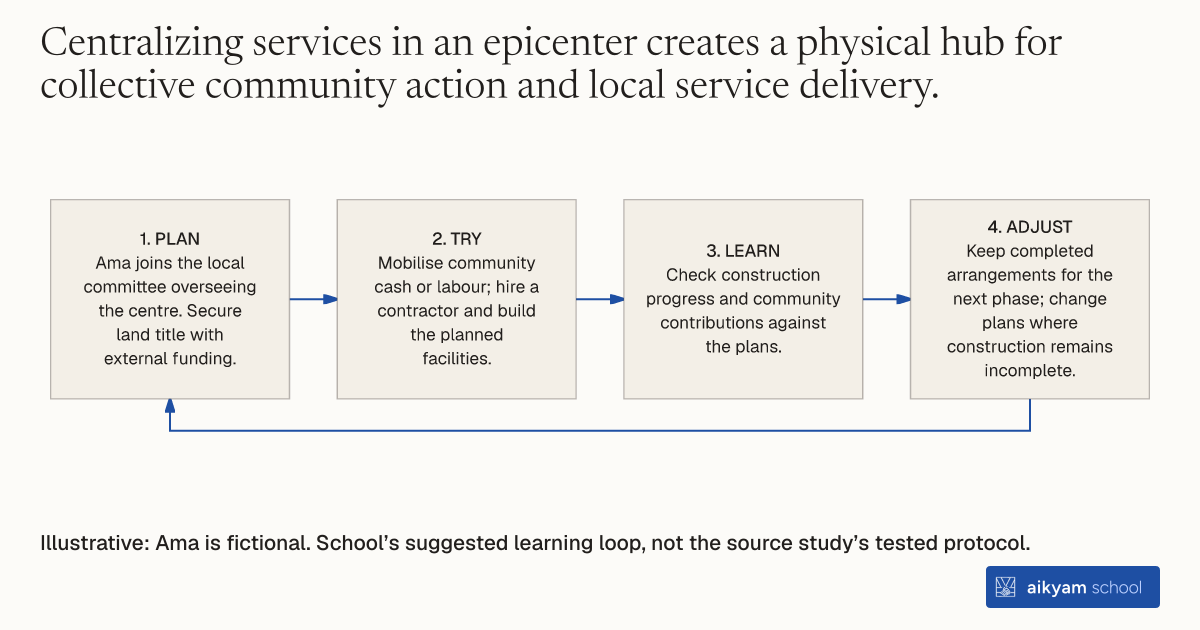
Try, learn and adjust
Check community centre construction
- Plan: Ama joins the local committee overseeing the centre. Secure land title with external funding.
- Try: Mobilise community cash or labour; hire a contractor and build the planned facilities.
- Learn: Check construction progress and community contributions against the plans.
- Adjust: Keep completed arrangements for the next phase; change plans where construction remains incomplete.
Illustrative: Ama is fictional. School’s suggested learning loop, not the source study’s tested protocol.
See source →School’s suggested learning loop: Observe contributions, construction and operation of services. This loop is separate from the evaluated programme.
How
When to use
Rural communities in developing regions often lack physical infrastructure and centralized locations for essential social services. Community-led epicenter development establishes multifunctional community centers to house health, education, and financial facilities. The method serves clusters of rural villages that demonstrate initial civic commitment and seek integrated service delivery.
Construct and operate a multi-purpose community center managed by a committee of local citizens.
- Form a committee of local citizens to oversee program design, mobilize community resources, and monitor construction.
- Secure title for the land using funds provided by the external organization.
- Require community members to contribute significant resources in cash or labor toward construction.
- Hire a contractor to oversee construction of a center containing meeting halls, clinics, rural banks, foodbanks, toilets, a demonstration farm, and a preschool or library.
- Operate integrated programs out of the completed center, including agricultural training, literacy classes, and microfinance services.
Why it works
Involving local committees in program management aligns activities with local priorities and reduces long-term dependence on outside funding.
Example
In Eastern Ghana, 28 of 51 village groupings invited to participate mobilized to build epicenters, with 25 groupings completing construction and 4 groupings constructing two epicenter buildings. Participating households contributed an average of 58.5 GHC in cash or labor toward epicenter construction and associated programming.
About the study
Participants
2,744 households across 97 village groupings in 13 districts of Eastern Ghana.
Study Design
Randomized evaluation using public lotteries to assign 51 village groupings to treatment and 46 to control over a five-year period.
Results
Mobilizing an epicenter increased household contributions to epicenter programming by 58.5 GHC and credit access by 0.556 standard deviations, but decreased voluntary contributions to non-epicenter public goods by 10 GHC and decreased local government investment in THP sectors by 6.8 percentage points.