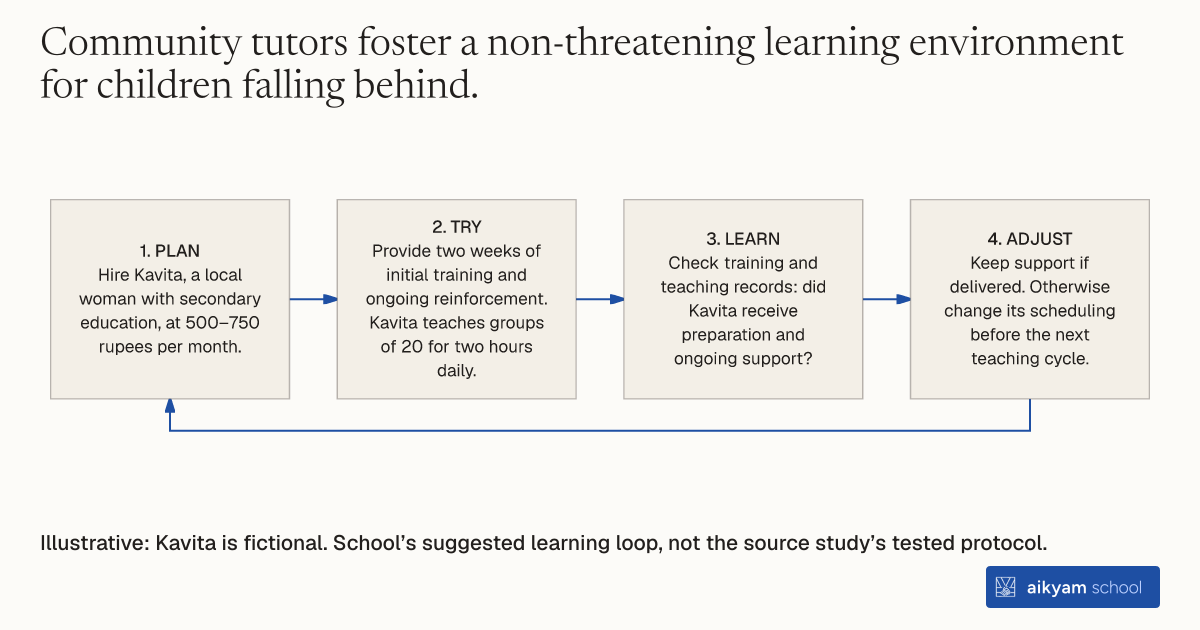
Try, learn and adjust
Check local tutor training and support
- Plan: Hire Kavita, a local woman with secondary education, at 500–750 rupees per month.
- Try: Provide two weeks of initial training and ongoing reinforcement. Kavita teaches groups of 20 for two hours daily.
- Learn: Check training and teaching records: did Kavita receive preparation and ongoing support?
- Adjust: Keep support if delivered. Otherwise change its scheduling before the next teaching cycle.
Illustrative: Kavita is fictional. School’s suggested learning loop, not the source study’s tested protocol.
See source →School’s suggested, untested learning loop. Observe training, reinforcement and teaching arrangements; do not assign programme effects to staffing alone.
How
When to use
Many government schools in developing countries lack the resources to provide individual support to struggling students. Standard teacher salaries are high, making additional certified teachers financially unfeasible. Hiring young local community members as tutors provides affordable instruction for lagging primary school children.
Recruit, train, and employ local community members as basic skill tutors for lagging primary school children.
- Program managers hire young women from the local community who completed at least secondary education.
- Program leaders pay each tutor a stipend of 500 to 750 rupees, or 10 to 15 US dollars, per month.
- Trainers conduct two weeks of training for tutors at the beginning of the school year.
- Program staff provide ongoing reinforcement to tutors throughout the school year.
- Tutors teach groups of 20 lagging students in available school space for two hours each day.
Why it works
Hiring local community members keeps program costs extremely low at 2.25 US dollars per child per year.
Example
Pratham hired local tutors called balsakhis across 123 primary schools in Vadodara and one district in Mumbai. These tutors increased student test scores by 0.27 standard deviations in the second year. Between 8 and 13 percent more marginalized students mastered core arithmetic tasks like subtraction and division.
About the study
Participants
Primary school students in Grades 2, 3, and 4 across 123 government schools in Vadodara and one school district in Mumbai, India.
Study Design
Randomized evaluation from 2001 to 2002 comparing treatment grades assigned tutors against comparison grades.
Results
Student test scores increased by 0.27 standard deviations in Year 2 at a cost of 2.25 US dollars per child per year.