In Simple Words
Deploying multi-faceted support bundles is like providing commuters with a fully chauffeured luxury limousine service that includes paid toll passes and free meals; while the service guarantees arrival, the high cost per passenger limits the service to a tiny fraction of travelers, making targeted repair services a more scalable public transit solution.
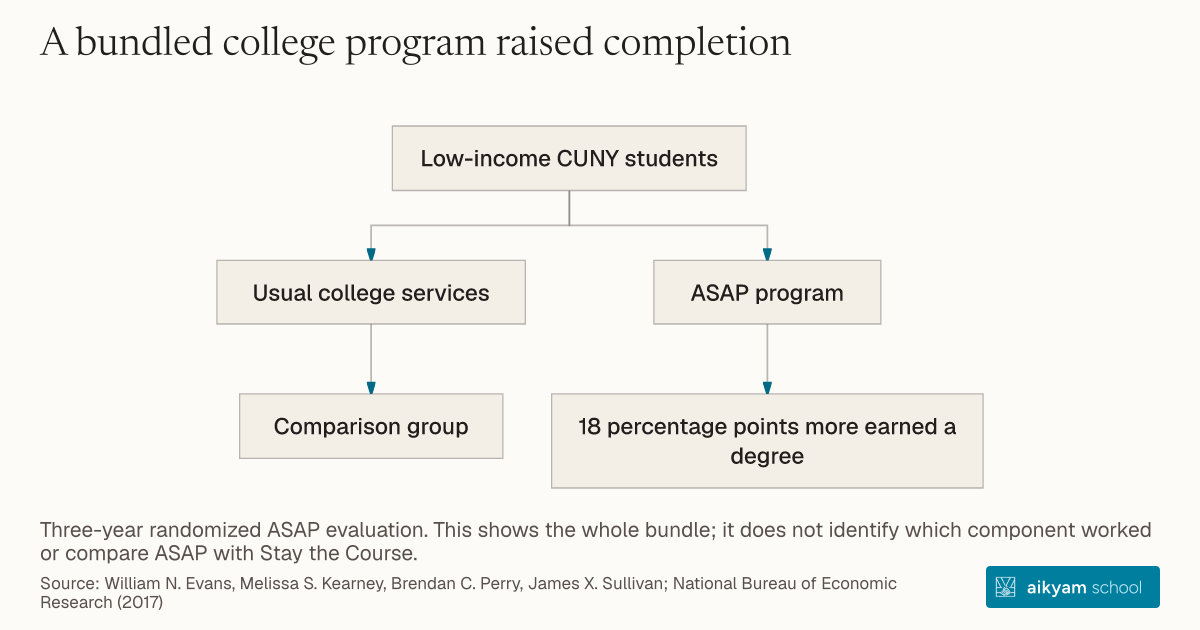
Low-income CUNY students
- Usual college services
- Comparison group
- ASAP program
- 18 percentage points more earned a degree
Three-year randomized ASAP evaluation. This shows the whole bundle; it does not identify which component worked or compare ASAP with Stay the Course.
See source →Research question
Comprehensive postsecondary support bundles that combine tuition waivers, blocked scheduling, and campus counseling produce large completion gains, but their extreme per-student financial costs restrict widespread institutional adoption and scalability.
Participants
Comparative RCT evaluation data between CUNY ASAP (N = 896) and Stay the Course (N = 869) community college interventions.
Study Design
Comparative cost-effectiveness analysis across multi-site randomized controlled trial evaluations in urban community colleges.
Results
CUNY ASAP nearly doubled graduation rates (18 percentage point increase) at an additional cost of $16,284 per student ($42,065 total three-year program cost), whereas Stay the Course achieved a 31.5 percentage point female degree increase at $5,640 per student.
Takeaway
Compare multi-faceted intervention proposals against targeted case management alternatives using per-graduate cost metrics rather than focusing exclusively on overall effect sizes.
Source and citation
See source →Read alongside the research
Plain-English glossary
Original explanations, informed by the references below. Examples are illustrations, not data from the studies above. The research text stays unchanged.
- Percentage points
The difference between two percentages.
ExampleA rise from 40% to 50% is 10 percentage points. Relative to the starting value, that is a 25% increase.
Office for National Statistics · Percentages ↗Read more about percentage points →- Randomized controlled trial
A study that uses chance, like drawing lots, to decide who receives each option being compared. Researchers compare the groups’ outcomes to estimate the effect of those options.
ExampleA lottery assigns volunteers to a training programme or a comparison group. Researchers then compare their outcomes.
GET-IT glossary · Randomized study ↗Read more about randomized controlled trial →