In Simple Words
Hiring local secondary-school educated young women to pull lagging students out of standard classes for two hours daily to focus strictly on foundational competencies operates like a dedicated athletic assistant who works separately with struggling team members to master basic footwork before returning to regular practice.
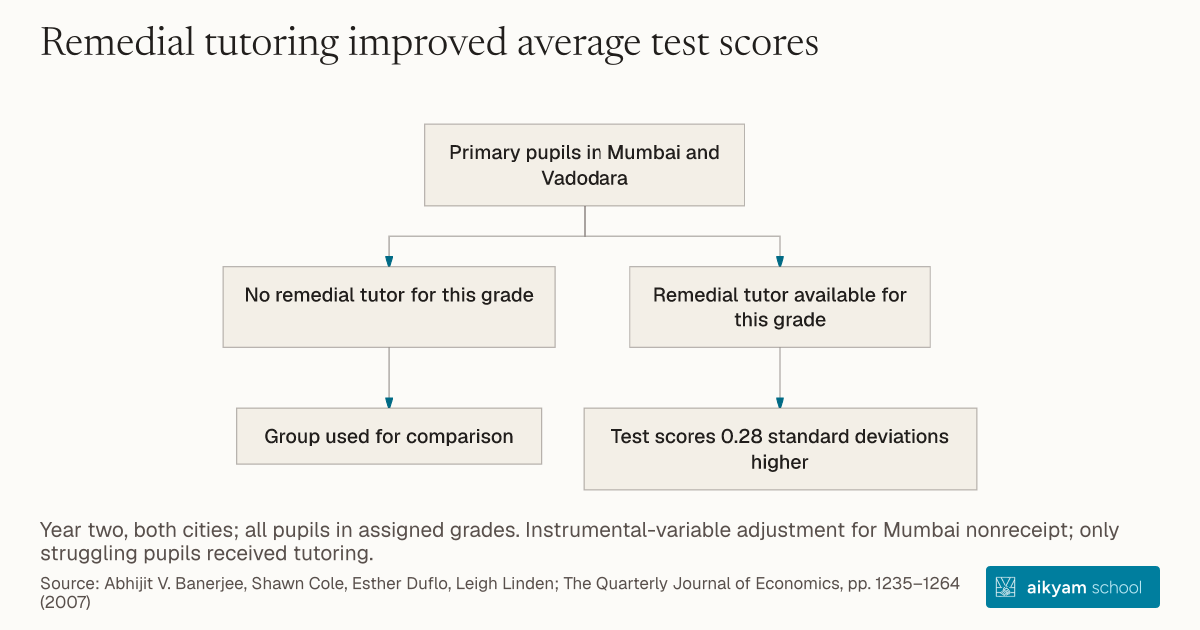
Primary pupils in Mumbai and Vadodara
- No remedial tutor for this grade
- Group used for comparison
- Remedial tutor available for this grade
- Test scores 0.28 standard deviations higher
Year two, both cities; all pupils in assigned grades. Instrumental-variable adjustment for Mumbai nonreceipt; only struggling pupils received tutoring.
See source →Research question
In urban primary schools in developing countries, rapid enrollment expansion without level-targeted instruction leaves millions of children unable to acquire basic reading and arithmetic skills.
Participants
N = 12,855 students in Year 1 and N = 21,936 students in Year 2 across primary government schools in Vadodara and Mumbai, India.
Study Design
Randomized Controlled Trial (RCT) assigning schools to treatment and comparison groups, utilizing instrumental variables to estimate direct treatment effects on assigned children.
Results
Remedial education increased average test scores in treatment schools by 0.14 standard deviations in year 1 and 0.28 standard deviations in year 2, with targeted bottom-third children gaining 0.40 standard deviations and directly assigned children gaining 0.60 standard deviations.
Takeaway
Employ secondary-school educated community members to provide two hours of daily targeted foundational literacy and numeracy tutoring to low-performing primary students outside the main classroom.
Source and citation
See source →Read alongside the research
Plain-English glossary
Original explanations, informed by the references below. Examples are illustrations, not data from the studies above. The research text stays unchanged.
- Randomized controlled trial
A study that uses chance, like drawing lots, to decide who receives each option being compared. Researchers compare the groups’ outcomes to estimate the effect of those options.
ExampleA lottery assigns volunteers to a training programme or a comparison group. Researchers then compare their outcomes.
GET-IT glossary · Randomized study ↗Read more about randomized controlled trial →