Try, learn and adjust
Check midterm feedback reaches teachers
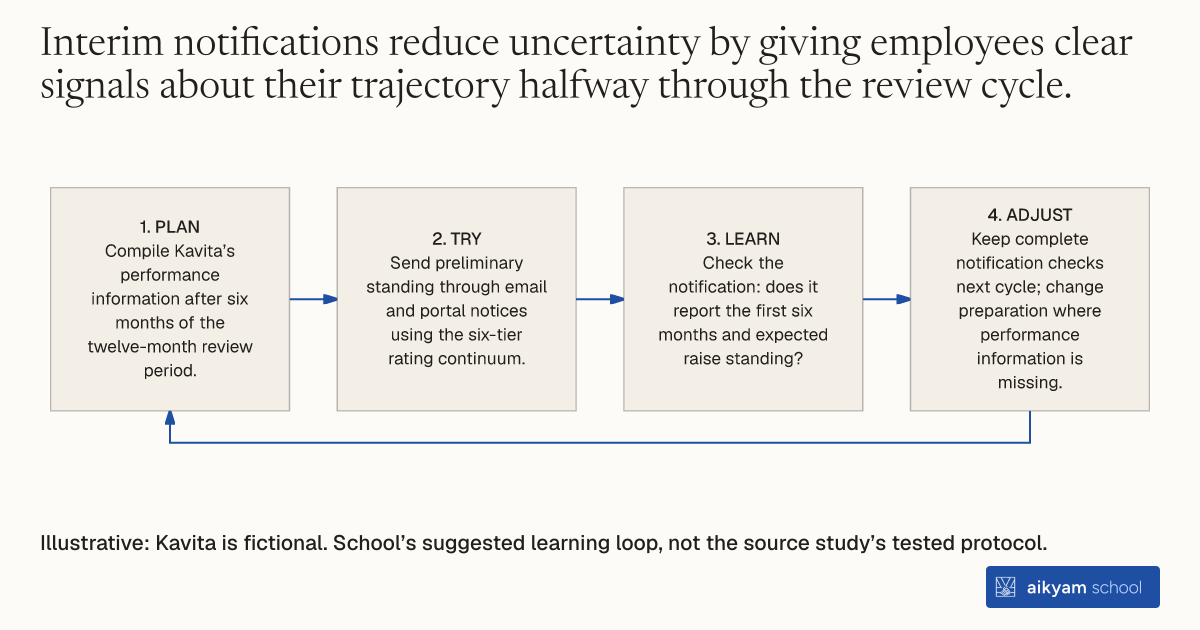
- Plan: Compile Kavita’s performance information after six months of the twelve-month review period.
- Try: Send preliminary standing through email and portal notices using the six-tier rating continuum.
- Learn: Check the notification: does it report the first six months and expected raise standing?
- Adjust: Keep complete notification checks next cycle; change preparation where performance information is missing.
Illustrative: Kavita is fictional. School’s suggested learning loop, not the source study’s tested protocol.
See source →School’s suggested, untested learning loop. Observe midterm notification content; comparison teachers also receive feedback, so feedback alone is not the tested pay effect.
How
When to use
School systems implementing annual incentive schemes face the problem of employee uncertainty during long evaluation periods. Without interim performance updates, workers cannot gauge their standing or adjust effort before final raise decisions occur. Providing midterm feedback notifications resolves information friction for teachers midway through a twelve-month review cycle.
Issue standardized midterm performance reports to teachers halfway through the review cycle to communicate preliminary standings and expected raise outcomes.
- Compile employee performance data after the first six months of the twelve-month review period.
- Calculate preliminary performance ranks or effort scores based on first-term subjective criteria ratings or student test score growth.
- Transmit individual midterm performance notes to teachers via direct email notifications and portal pop-ups during the summer break.
- Display a six-tier performance rating continuum from unsatisfactory to excellent on each notification sheet to indicate expected raise standings.
- Provide control group teachers with midterm feedback on either subjective effort or test metrics to hold information provision constant across contracts.
Why it works
Holding information feedback constant across treatment and control arms ensures that observed productivity differences stem from financial incentive structures rather than mere information provision.
Example
A private school network in Pakistan distributed midterm performance notes to teachers in July halfway through a twelve-month review cycle across 234 schools. In subjective treatment schools, notifications displayed preliminary ratings across four effort criteria, giving teachers clear feedback on whether they were on track for standard or above-average raise tiers.
About the study
Participants
6,080 teachers (80% female) and 189 managers across 234 private schools in Pakistan (grades 4–13).
Study Design
Randomized controlled trial (RCT) holding performance feedback provision constant across control, subjective raise, and objective raise arms using midterm email and portal notifications during an 18-month trial.
Results
Halfway through the year, teachers received midterm rank information; 60% of teachers correctly identified key raise features at endline, and overall incentive treatments increased endline test scores by 0.086 to 0.092 standard deviations while maintaining equal information access.