Parallel research sessions
Collect parent and child data
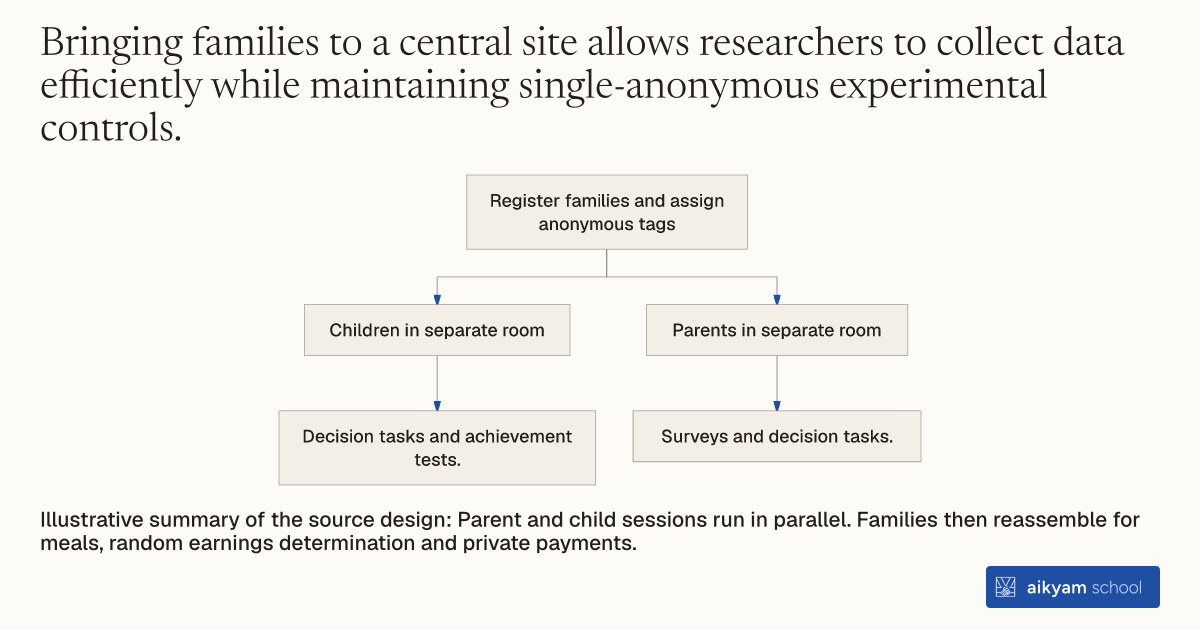
Register families and assign anonymous tags
- Children in separate room
- Decision tasks and achievement tests.
- Parents in separate room
- Surveys and decision tasks.
Illustrative summary of the source design: Parent and child sessions run in parallel. Families then reassemble for meals, random earnings determination and private payments.
See source →How
When to use
Researchers need to gather experimental and survey data simultaneously from low-income parents and their children. Conducting separate home or school visits is time-consuming and risks inconsistent testing conditions across subjects. This method brings parents and children together to a central location for synchronized experimental tasks, testing, and surveys.
Host multi-hour evaluation events to gather experimental decision data and test scores from parents and children simultaneously.
- Invite sampled families to evaluation events hosted at local schools or community facilities.
- Provide registration check-in where parents and children receive random identification tags to preserve anonymity.
- Convene families in a central room for refreshments and brief instructions regarding room assignments.
- Separate parents and children into distinct rooms for decision-making tasks, ice-breaker games, and surveys.
- Administer economic dictator games and standardized achievement tests to children while parents complete surveys and decision tasks in parallel rooms.
- Reassemble families in the central room for meals, random earnings determination, and private cash or gift certificate payments.
Why it works
Running parallel parent and child sessions eliminates parental influence on children's choices while providing refreshments and show-up fees maintains high attendance.
Example
In 2001, researchers in Toledo, Ohio, hosted 2.5-hour evaluation events for 101 low-income families and private sessions for 26 families. Participants completed economic games, standardized tests, and surveys, earning show-up fees of \$15 to \$50 for parents and \$5 in gift certificates for children.
About the study
Participants
208 children and 127 parents representing 127 low-income applicant families in Toledo, Ohio, where 57 percent were African-American.
Study Design
Single-blind, single-anonymous experimental field evaluation combining dictator games, California Achievement Tests, and parent surveys across group and individual sessions.
Results
Successfully collected experimental, test score, and survey data across 127 families, achieving a 100 percent completion rate for attending families during 2.5-hour sessions.