Research games
Measure donations to charities
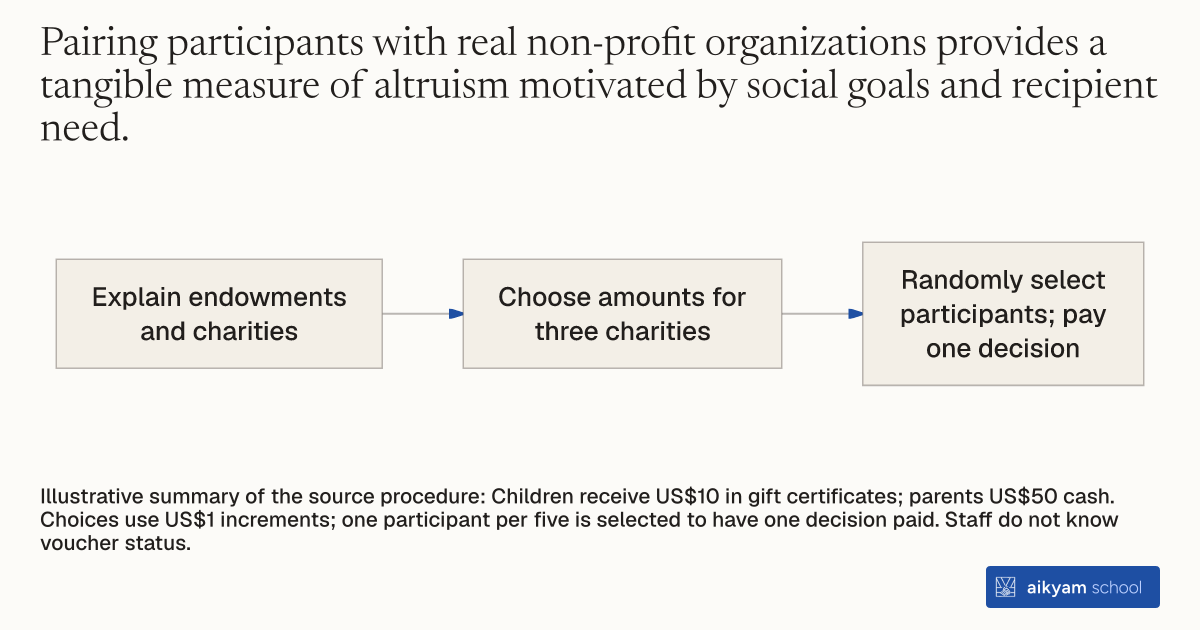
- Explain endowments and charities
- Choose amounts for three charities
- Randomly select participants; pay one decision
Illustrative summary of the source procedure: Children receive US$10 in gift certificates; parents US$50 cash. Choices use US$1 increments; one participant per five is selected to have one decision paid. Staff do not know voucher status.
See source →How
When to use
Evaluators need to measure social traits like altruism in young school-age children following an educational intervention. Direct observational data on children's charitable giving is usually unobservable in tax records or household surveys. This method uses structured economic dictator games paired with real non-profit organizations to quantify charitable giving among elementary and junior high students.
Measure children's charitable altruism by having subjects make real monetary allocation choices in single-blind dictator games paired with non-profit organizations.
- Endow participating children with \$10 in Toys-R-Us gift certificates and parents with \$50 in cash.
- Read game instructions aloud and provide written descriptions of three non-profit charities: The American Red Cross, Make-A-Wish, and The Children's Scholarship Fund of Toledo.
- Ask subjects to decide in three separate decisions how much of their endowment to keep for themselves and how much to send to each charity in \$1 increments.
- Provide envelopes and an option to receive a thank-you letter from the organization to ensure subjects believe donations will be delivered.
- Keep experimenters uninformed about whether subjects are voucher winners or losers during sessions to prevent experimenter bias.
- Select one participant out of every five at random at the end of the session to execute and pay one decision, controlling for wealth effects.
Why it works
Simple decision sheets with real financial consequences allow researchers to observe genuine generosity in children that surveys cannot accurately capture.
Example
In 2001, researchers in Toledo, Ohio, administered dictator games to 191 low-income children whose families applied to a scholarship lottery in 1998. Children who won tuition vouchers donated \$0.75 more on average out of their \$10 endowment to charitable organizations than unsuccessful applicants who gave an average of \$3.33.
About the study
Participants
191 children (average age 10, 4th grade, 54 percent female, majority African-American) from low-income applicant families in Toledo, Ohio.
Study Design
Single-blind, single-anonymous economic laboratory experiment comparing voucher lottery winners to control group losers 3 to 4 years after the initial lottery.
Results
Voucher winners gave 23 percent (\$0.75) more to charities than losers, including \$1.19 more to the Red Cross, \$0.515 more to Make-A-Wish, and \$0.708 more to the Children's Scholarship Fund.