Research games
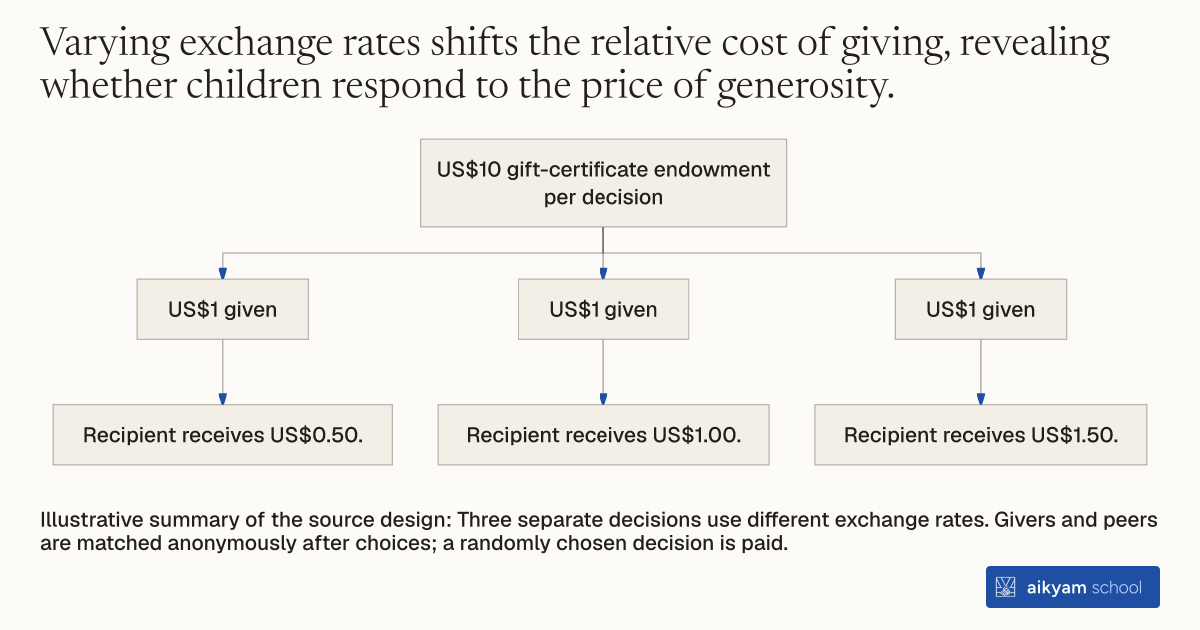
Vary the value of peer gifts
US$10 gift-certificate endowment per decision
- US$1 given
- Recipient receives US$0.50.
- US$1 given
- Recipient receives US$1.00.
- US$1 given
- Recipient receives US$1.50.
Illustrative summary of the source design: Three separate decisions use different exchange rates. Givers and peers are matched anonymously after choices; a randomly chosen decision is paid.
See source →How
When to use
Researchers need to test whether an educational program changes children's generosity toward their peers. Observing children's direct sharing with classmates in natural settings is difficult and confounded by social pressure. This method measures peer generosity by having children complete economic dictator games with anonymous peers under varying exchange rates.
Measure peer generosity by varying the exchange rate of gift certificates given to an anonymous peer across dictator decisions.
- Endow participating children with \$10 in Toys-R-Us gift certificates for three separate decision tasks.
- Explain that any certificates shared will go to an anonymous child attending the same evaluation event.
- Set the exchange rate for each decision so that every \$1 given becomes \$0.50, \$1.00, or \$1.50 for the recipient.
- Direct children to record how much to keep and how much to give on structured decision sheets.
- Randomly and anonymously match givers with recipients at the end of the session without revealing identities.
- Pay one randomly chosen decision per participant at the end of the event to preserve real financial incentives.
Why it works
Anonymous recipient matching isolates pure peer altruism from social pressure or expectations of reciprocity.
Example
In 2001, researchers in Toledo, Ohio, conducted peer dictator games with 191 applicant children from a voucher lottery. Children gave an average of \$2.61 out of \$10 to peers, with voucher winners and losers giving nearly identical amounts.
About the study
Participants
191 children (average age 10, 4th grade, 54 percent female, majority African-American) from low-income families in Toledo, Ohio.
Study Design
Single-blind, single-anonymous economic experiment comparing scholarship lottery winners and losers across three dictator decisions with exchange rates of 50 percent, 100 percent, and 150 percent.
Results
Voucher lottery winners showed no statistically significant difference in peer giving compared to losers (-\$0.112 difference), while increasing the exchange rate reduced peer giving (-\$0.221 per rate increment).