Research steps
Account for hourly grid emissions
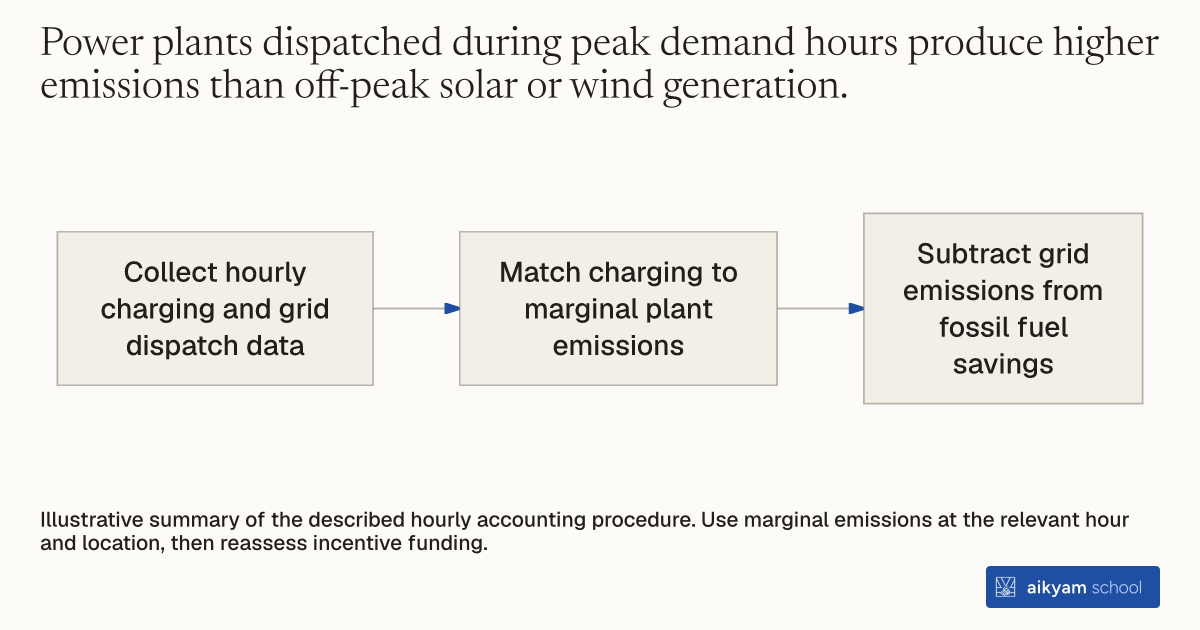
- Collect hourly charging and grid dispatch data
- Match charging to marginal plant emissions
- Subtract grid emissions from fossil fuel savings
Illustrative summary of the described hourly accounting procedure. Use marginal emissions at the relevant hour and location, then reassess incentive funding.
See source →How
When to use
Average grid emissions factors miscalculate real greenhouse gas reductions from electrification programs. Net carbon reductions depend on the specific power plant dispatched at a precise hour and location. Climate analysts need marginal accounting when evaluating municipal vehicle electrification subsidies.
Calculate net carbon reductions using hourly marginal grid emissions data instead of average annual emissions factors.
- Climate analysts gather hourly vehicle charging datasets across the regional transportation fleet.
- Program staff collect hourly wholesale power market generation and dispatch records.
- Analysts match vehicle electricity consumption timestamps to marginal power plant emissions at each specific hour.
- Program officers calculate total avoided emissions by subtracting marginal power grid emissions from baseline fossil fuel savings.
- Re-evaluate municipal vehicle incentive funding using hourly marginal emissions accounting.
Why it works
Measuring hourly marginal emissions prevents policy makers from overestimating carbon savings from evening vehicle charging.
Example
An evaluation of California's electric vehicle subsidy program incorporated hourly marginal electricity grid emissions. Accounting for marginal emissions showed that actual program carbon reductions were substantially smaller than predictions made under average grid assumptions.
About the study
Participants
Vehicle owners participating in California's Enhanced Fleet Modernization Program alongside regional electricity grid operators.
Study Design
Quasi-experimental structural estimation linking hourly household vehicle miles traveled, hourly power plant dispatch models, and time-of-use electricity pricing.
Results
Incorporating marginal emissions showed that program carbon reduction effectiveness was substantially smaller than assumed under traditional average grid factor accounting.