Try, learn and adjust
Check rent subsidy calculations at annual review
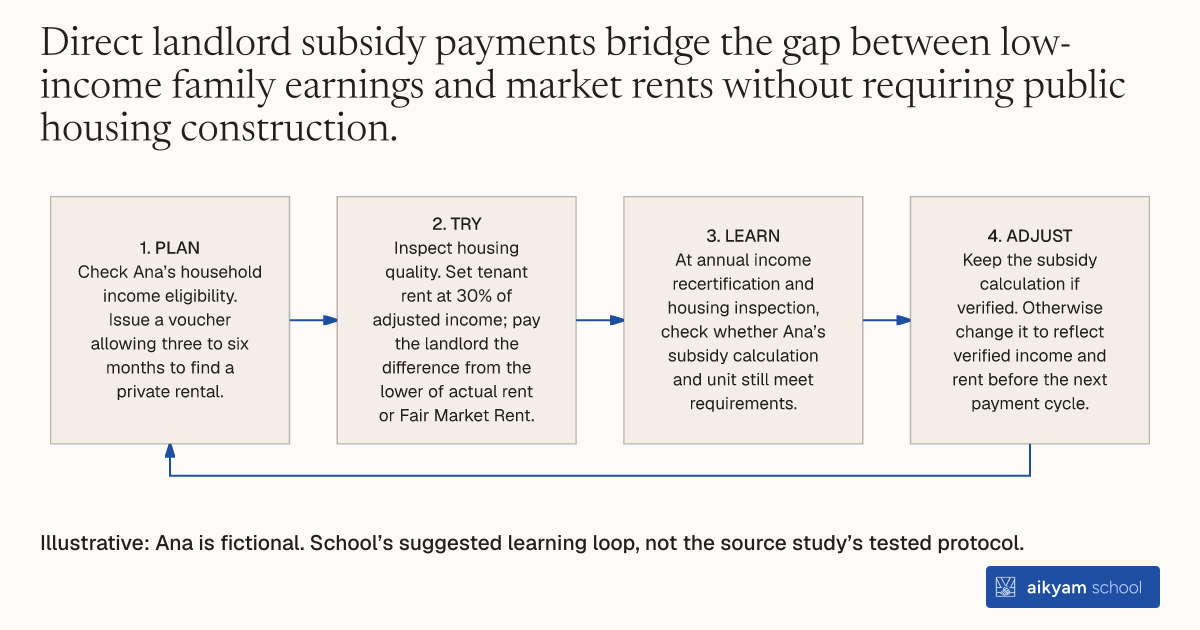
- Plan: Check Ana’s household income eligibility. Issue a voucher allowing three to six months to find a private rental.
- Try: Inspect housing quality. Set tenant rent at 30% of adjusted income; pay the landlord the difference from the lower of actual rent or Fair Market Rent.
- Learn: At annual income recertification and housing inspection, check whether Ana’s subsidy calculation and unit still meet requirements.
- Adjust: Keep the subsidy calculation if verified. Otherwise change it to reflect verified income and rent before the next payment cycle.
Illustrative: Ana is fictional. School’s suggested learning loop, not the source study’s tested protocol.
See source →School’s suggested learning loop, not a source-tested procedure. Observe income records, rent calculations and housing inspections; do not infer employment effects from these checks.
How
When to use
Low-income families face high housing cost burdens in private rental markets. Tenant-based housing vouchers subsidize private-market rent while allowing families to choose where to live. This approach assists eligible low-income households by capping their out-of-pocket rent at thirty percent of adjusted income.
Deliver tenant-based housing assistance vouchers to subsidize private-market rent for low-income households.
- Determine household income eligibility relative to local area median income limits.
- Issue a housing choice voucher granting the recipient family a three-to-six-month window to locate a private-market rental unit.
- Inspect the chosen rental unit to verify compliance with minimum housing quality standards.
- Calculate the recipient family's required tenant rent contribution as 30 percent of adjusted household income.
- Pay the private landlord a direct monthly subsidy equal to the difference between the tenant rent contribution and the lesser of actual unit rent or the local Fair Market Rent.
- Recertify household income and inspect housing quality annually using HUD Form 50058 records to maintain subsidy eligibility.
Why it works
Setting tenant rent payments at thirty percent of income ensures housing remains affordable while allowing families mobility in the private housing market.
Example
In Chicago, Illinois, the Chicago Housing Authority Corporation offered Section 8 vouchers to lottery applicants, paying private landlords an average maximum subsidy of $8,265 per year based on an average Fair Market Rent of $12,000 per year, while requiring recipient households to pay an average out-of-pocket rent contribution of $3,735 per year.
About the study
Participants
42,358 working-age, able-bodied adults living in private housing in Chicago, Illinois (11,696 treatment group, 30,662 control group; 94% black, 89% female, baseline income ~$14,000/year).
Study Design
Randomized lottery evaluation using administrative records from IDES UI earnings and IDHS public assistance to measure intent-to-treat and 2SLS instrumental variables impacts of voucher utilization from 1997 through 2005.
Results
Voucher utilization reduced quarterly employment by 3.6 percentage points (6 percent of control complier mean), decreased quarterly earnings by $329 (10 percent), and increased social program participation by 6.7 percentage points (12 percent).