Research steps
Allocate vouchers through a random waiting list
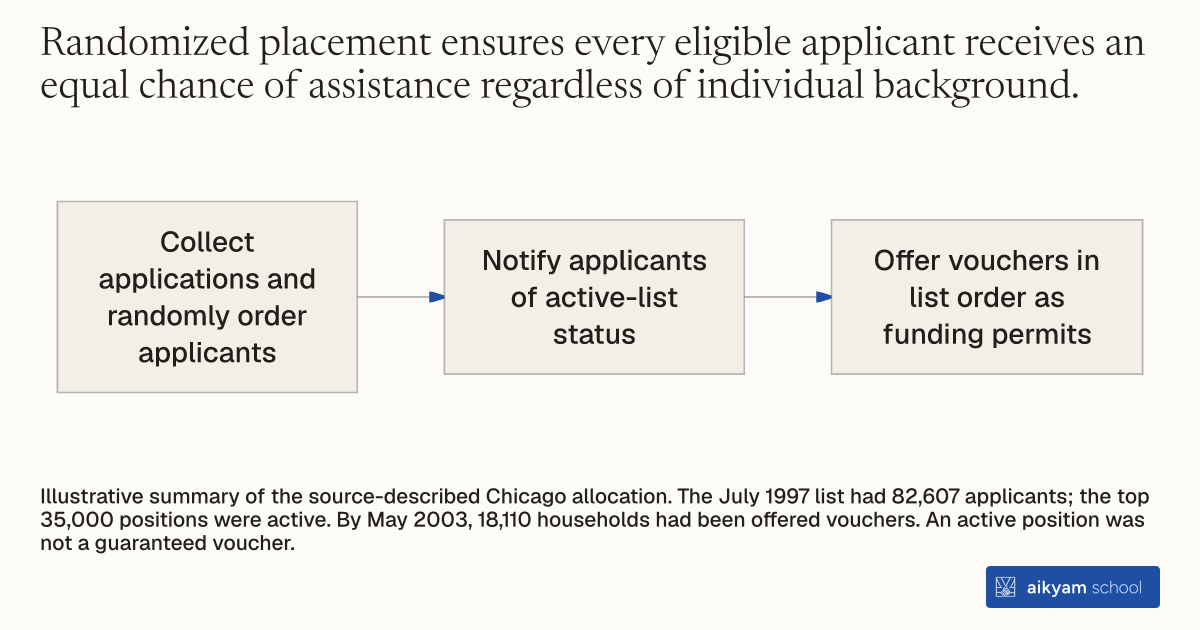
- Collect applications and randomly order applicants
- Notify applicants of active-list status
- Offer vouchers in list order as funding permits
Illustrative summary of the source-described Chicago allocation. The July 1997 list had 82,607 applicants; the top 35,000 positions were active. By May 2003, 18,110 households had been offered vouchers. An active position was not a guaranteed voucher.
See source →How
When to use
Demand for social program benefits often exceeds available government funding. A lottery allocates scarce housing vouchers fairly among eligible low-income applicants while eliminating selection bias. This approach provides an equitable distribution system for public housing authorities.
Allocate scarce housing assistance vouchers to low-income applicants using a computer-generated random lottery.
- Open the program application window to collect baseline household forms from income-eligible families.
- Assign every applicant a random numerical position on the master waiting list.
- Notify applicants assigned to the active top range of their list numbers and estimated timeline for voucher offers.
- Inform applicants with lottery numbers below the active threshold that they will not receive assistance.
- Offer available vouchers sequentially down the randomized wait list as agency funding permits.
Why it works
This procedure removes preference bias and creates statistically identical treatment and control groups for policy evaluation.
Example
The Chicago Housing Authority Corporation opened its Section 8 waiting list in July 1997, receiving 82,607 applications from income-eligible families. Officials randomly ordered all applicants, designated the top 35,000 positions as active, and offered vouchers to 18,110 households by May 2003.
About the study
Participants
42,358 working-age, able-bodied adults living in private-market housing in Chicago, Illinois (11,696 treatment households offered vouchers, 30,662 control households).
Study Design
Randomized field experiment evaluating an intent-to-treat lottery design linked to state unemployment insurance and welfare administrative records from 1997 through 2005.
Results
Assignment to an active wait-list position increased voucher receipt by 42.6 percentage points and enabled unbiased evaluation of subsequent labor market outcomes.