Research flow
Classify baseline leadership
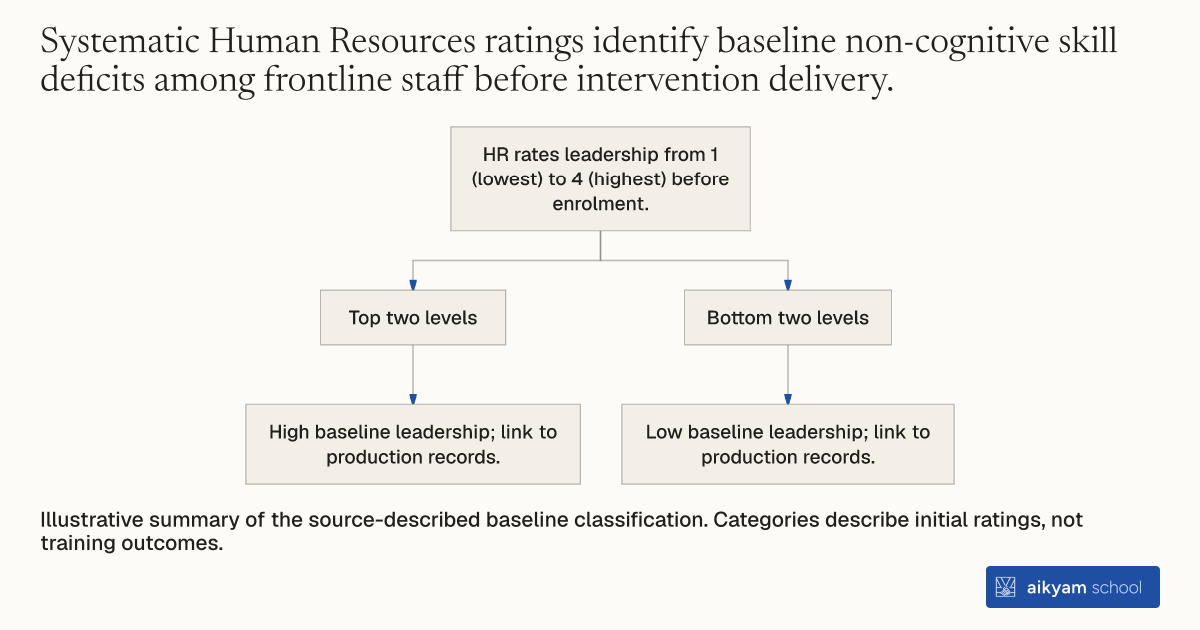
HR rates leadership from 1 (lowest) to 4 (highest) before enrolment.
- Top two levels
- High baseline leadership; link to production records.
- Bottom two levels
- Low baseline leadership; link to production records.
Illustrative summary of the source-described baseline classification. Categories describe initial ratings, not training outcomes.
See source →How
When to use
Frontline manufacturing supervisors often lack objective baseline measures to identify which workers suffer from severe soft skill deficits. This lack of diagnostic information prevents firm managers from targeting remedial life skills training to employees who need it most. Rate frontline worker leadership potential across four standardized baseline tiers using Human Resources evaluation forms before assigning workplace interventions.
Classify frontline machine operators into four baseline leadership skill tiers prior to program deployment using standardized Human Resources evaluation scores.
- Distribute standardized baseline assessment forms to factory Human Resources representatives prior to program enrollment.
- Instruct Human Resources representatives to evaluate each worker's baseline leadership capacity and workplace initiative.
- Assign each evaluated worker a baseline leadership rating on a discrete four-point scale ranging from one for lowest to four for highest leadership skill.
- Group workers scoring in the top two rating levels into a high baseline leadership category.
- Place workers scoring in the bottom two rating levels into a low baseline leadership category.
- Link baseline leadership classifications to worker production records to evaluate skill heterogeneity and target remedial training.
Why it works
Classifying workers by baseline skill stock allows managers to confirm that adult soft skills training acts as a substitute for initial skill deficits.
Example
Factory Human Resources representatives rated 2,703 female garment operators across five export plants in Bengaluru, India on a four-tier baseline leadership scale prior to soft skills training. Evaluation data revealed that workers in the lower baseline leadership tiers achieved significantly higher productivity gains from training than those entering with high baseline scores.
About the study
Participants
2,703 female garment workers across 112 production lines in 5 export factories in Bengaluru, India.
Study Design
Two-stage randomized controlled trial using baseline four-tier HR leadership ratings interacted with treatment status in panel regressions controlling for worker baseline efficiency and attendance.
Results
Treatment efficiency gains were 4.30 percentage points lower for workers classified in the top two baseline leadership tiers compared to those in the bottom two tiers (p < 0.05), confirming soft skills training acts as a substitute for baseline leadership deficits.