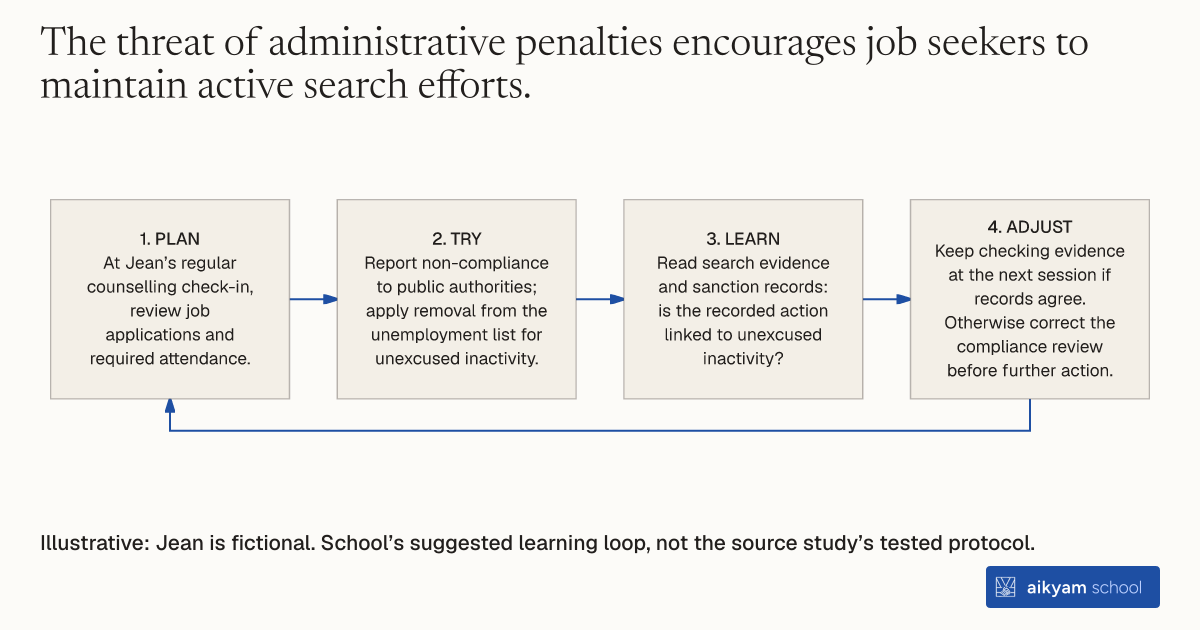
Try, learn and adjust
Check search compliance and recorded sanctions
- Plan: At Jean’s regular counselling check-in, review job applications and required attendance.
- Try: Report non-compliance to public authorities; apply removal from the unemployment list for unexcused inactivity.
- Learn: Read search evidence and sanction records: is the recorded action linked to unexcused inactivity?
- Adjust: Keep checking evidence at the next session if records agree. Otherwise correct the compliance review before further action.
Illustrative: Jean is fictional. School’s suggested learning loop, not the source study’s tested protocol.
See source →School’s suggested learning loop: observe search activity, attendance and temporary or permanent removal records. This loop does not establish that sanctions improve employment.
How
When to use
Job counseling programs rely on participant effort to achieve job placement. Without compliance enforcement, some job seekers become inactive while continuing to receive unemployment benefits. Monitoring search activity and applying administrative sanctions maintains search intensity among enrolled job seekers.
Monitor job search compliance during counseling sessions and enforce administrative sanctions against inactive benefit recipients.
- Review participant job applications and search activity during regular counseling check-ins.
- Identify participants who fail to meet mandatory job search or attendance requirements.
- Report non-compliant participants to public authorities for administrative action.
- Apply temporary or permanent removal from the unemployment list for unexcused inactivity.
Why it works
Regular compliance checks prevent inactivity and ensure candidates adhere to program search requirements.
Example
ANPE advisors monitored participant search compliance in 2007 across 216 public employment offices in France. Public advisors reviewed job search evidence and issued administrative sanctions to inactive job seekers.
About the study
Participants
Nearly 44,000 job seekers entering unemployment and entitled to at least one year of benefits across 216 local public employment offices in four French administrative regions.
Study Design
Randomized controlled trial conducted from January to December 2007 tracking administrative sanction records and employment status over 12 months across public and private counseling programs.
Results
Private providers applied sanctions, including temporary or permanent removal from the unemployment list, less frequently than public services, reducing overall candidate search effort.