In Simple Words
Think of a personal fitness trainer at a public community gym who works with a small group of 40 people instead of a crowded class of 120. The trainer meets with each person every single week to give direct advice, refine their exercise routine, and keep them accountable until they achieve their fitness targets.
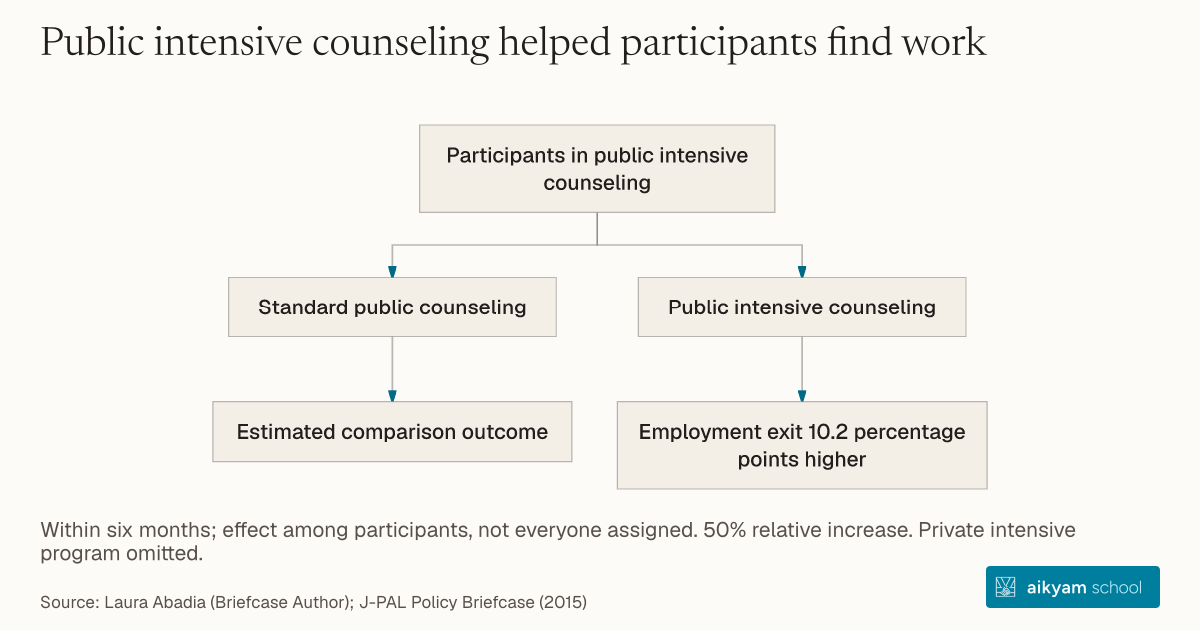
Participants in public intensive counseling
- Standard public counseling
- Estimated comparison outcome
- Public intensive counseling
- Employment exit 10.2 percentage points higher
For public intensive participants, the estimated six-month effect on exiting unemployment into work was +10.2 percentage points relative to their counterfactual standard counseling outcome. Within six months; effect among participants, not everyone assigned. 50% relative increase. Private intensive program omitted.
See source →Research question
Long-term unemployment creates severe individual socio-economic costs like poverty, skill degradation, and narrowed social networks. Intensive public job search counseling aims to accelerate job placement for individuals at risk of long-term unemployment through low caseworker-to-client ratios.
Participants
Nearly 44,000 job seekers entering unemployment entitled to at least one year of unemployment benefits across 216 local public employment offices in four French administrative regions.
Study Design
Randomized controlled trial (RCT) conducted from January to December 2007 tracking participants via administrative and survey data over a 12-month period across public intensive, private intensive, and standard public comparison groups.
Results
Assigned personal advisors to maximum 40 clients for weekly meetings over six months at an estimated cost of €657 per client. Increased exit rate to employment by 50% within six months (a 10.2 percentage point increase from a baseline of 20.7%). Increased likelihood of finding a job lasting at least six months by 34% (a 7.2 percentage point increase). Reduced net costs to government per job seeker slightly, though the cost difference was not statistically significant.
Takeaway
Cap public employment caseworker caseloads at 40 clients and implement mandatory weekly individual job search meetings.
Source and citation
See source →Read alongside the research
Plain-English glossary
Original explanations, informed by the references below. Examples are illustrations, not data from the studies above. The research text stays unchanged.
- Percentage points
The difference between two percentages.
ExampleA rise from 40% to 50% is 10 percentage points. Relative to the starting value, that is a 25% increase.
Office for National Statistics · Percentages ↗Read more about percentage points →- Randomized controlled trial
A study that uses chance, like drawing lots, to decide who receives each option being compared. Researchers compare the groups’ outcomes to estimate the effect of those options.
ExampleA lottery assigns volunteers to a training programme or a comparison group. Researchers then compare their outcomes.
GET-IT glossary · Randomized study ↗Read more about randomized controlled trial →- Statistically significant
A label used when a result passes a chosen statistical threshold, often p < 0.05. It does not show how large or useful an effect is. A result that is not statistically significant does not prove there is no effect.
ExampleA study reports p = 0.03 against a 0.05 threshold. It passes that test, but the effect could still be too small to matter.
American Statistical Association · Statement on p-values ↗Read more about statistically significant →