Research procedure
Follow farmers by phone
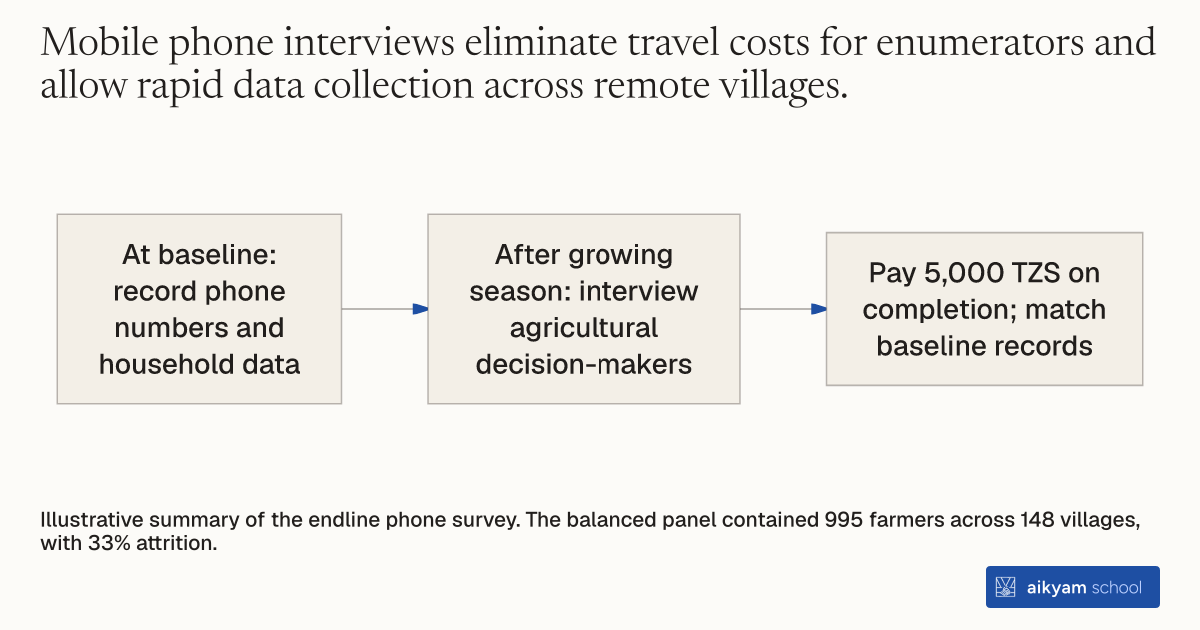
- At baseline: record phone numbers and household data
- After growing season: interview agricultural decision-makers
- Pay 5,000 TZS on completion; match baseline records
Illustrative summary of the endline phone survey. The balanced panel contained 995 farmers across 148 villages, with 33% attrition.
See source →How
When to use
Field evaluators face high costs and logistical delays when gathering follow-up impact data from geographically dispersed rural households. In-person household resurveys over large regions are slow and expensive to conduct after experimental interventions. Evaluators use this method to collect low-cost, high-frequency panel data from rural smallholders using incentivized phone calls.
Collect follow-up panel data from household decision-makers through structured phone interviews incentivized with direct mobile money transfers.
- Record respondent mobile phone numbers and baseline household characteristics during initial in-person baseline visits.
- Structure follow-up phone questionnaires around a few easy-to-recall variables like seasonal input purchases, prices paid, and quality beliefs.
- Train enumerators to conduct phone interviews using pre-filled digital entry forms.
- Contact primary agricultural decision-makers by telephone following the main growing season.
- Remit a direct mobile cash payment of 5,000 TZS to the respondent's phone upon survey completion.
- Check reported data against baseline records to verify panel continuity and assess treatment impacts.
Why it works
Direct mobile financial transfers compensate farmers for their time, maintaining panel participation across agricultural seasons.
Example
Enumerators conducted endline phone surveys with 995 farmers across 148 rural villages in Morogoro Region, Tanzania following the 2019 long rains season. Respondents received a direct mobile payment of 5,000 TZS per call, allowing researchers to measure a 27% increase in urea fertiliser adoption and a 30% reduction in quality concerns.
About the study
Participants
N = 995 farmers in a balanced panel across 148 villages in Morogoro Region, Tanzania.
Study Design
Clustered randomized trial follow-up panel phone survey with 5,000 TZS completion payments and ANCOVA/DiD impact estimations.
Results
Endline phone surveys successfully reached 995 baseline farmers (a 33% attrition rate in line with regional phone panels) and documented that the information intervention increased urea purchase likelihood by 10.6 percentage points (p < 0.01).