Research steps
Record mid-season crop performance
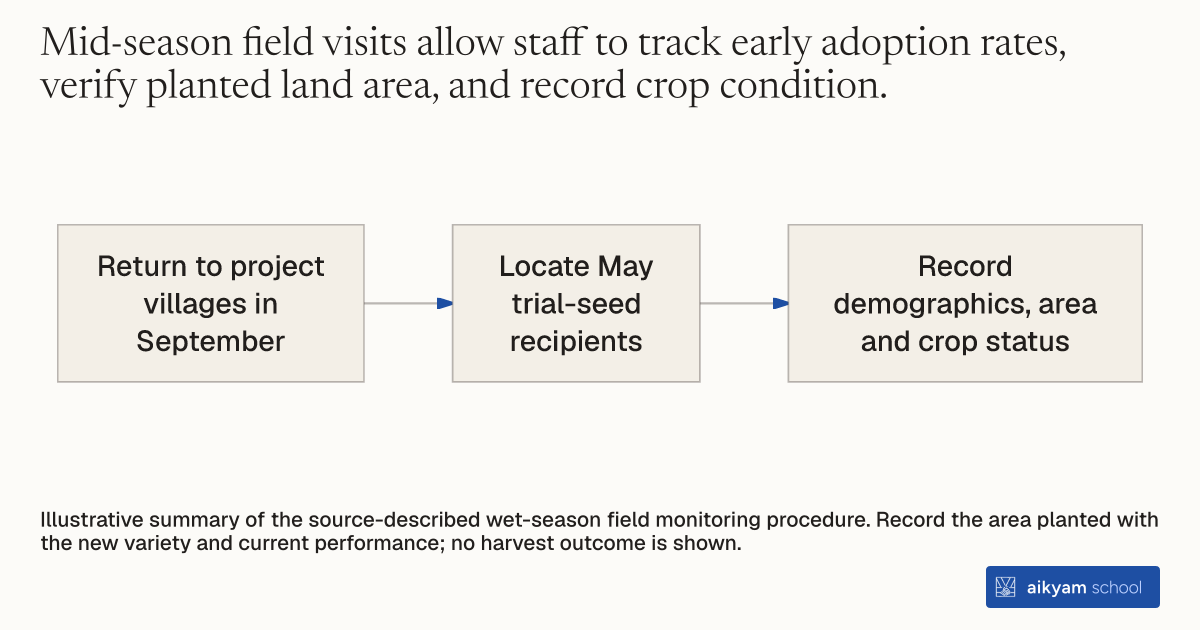
- Return to project villages in September
- Locate May trial-seed recipients
- Record demographics, area and crop status
Illustrative summary of the source-described wet-season field monitoring procedure. Record the area planted with the new variety and current performance; no harvest outcome is shown.
See source →How
When to use
Program managers need to track field progress and verify early adopters' cultivation outcomes before hosting peer demonstrations. This method collects mid-season data from early technology adopters during the growing cycle. It provides baseline performance metrics and demographic verification before public field days occur.
Conduct mid-season field visits to early adopter farms to collect cultivation, area, and crop performance data.
- NGO staff return to all project villages in September during the wet growing season.
- NGO staff locate selected early adopters who received trial seed packets in May.
- NGO staff record demographic details for each early adopter.
- NGO staff measure the total land area planted with the new seed variety.
- NGO staff assess and log current crop performance in the field.
Why it works
Gathering these intermediate metrics ensures reliable performance information before holding community learning events.
Example
In September 2014, NGO staff visited all 100 study villages in Odisha, India, to survey early adopters who received five-kilogram packets of flood-tolerant Swarna-Sub1 rice seed. Staff collected demographic data, measured planted acreage, and evaluated mid-season crop performance prior to launching pre-harvest field days in November.
About the study
Participants
100 villages in Odisha, India; rice-farming households where two-thirds lived below the US\$2.15/day poverty line.
Study Design
Mid-season field survey conducted in September 2014 across all 100 treatment and comparison villages following initial seed distribution in May 2014.
Results
Mid-season survey verified planted land area and crop health across 100 villages, establishing early adopter baseline data prior to randomized assignment of farmer field days.