Research procedure
Follow inputs, then harvest
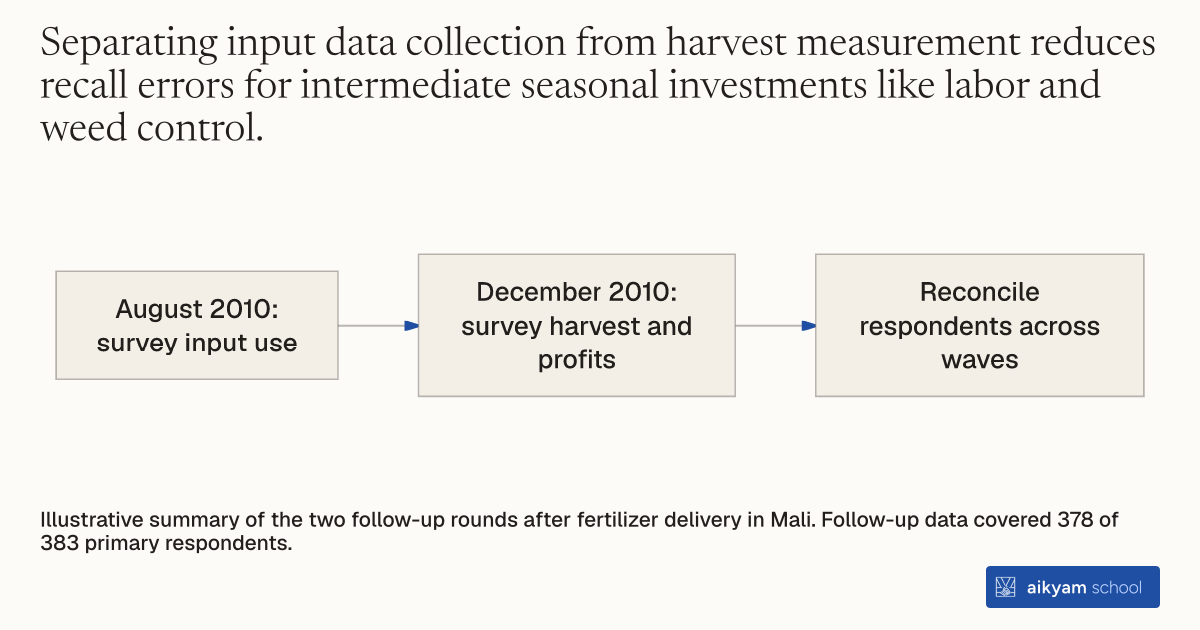
- August 2010: survey input use
- December 2010: survey harvest and profits
- Reconcile respondents across waves
Illustrative summary of the two follow-up rounds after fertilizer delivery in Mali. Follow-up data covered 378 of 383 primary respondents.
See source →How
When to use
Use this method when measuring agricultural inputs and seasonal harvest outcomes without relying on long-term recall memory. It solves the problem of recall bias caused by collecting intermediate input decisions only at the end of the agricultural season. It is designed for researchers and project evaluators tracking seasonal farming interventions across rural communities.
Execute a two-stage follow-up survey protocol to capture intermediate input choices during cultivation and harvest outcomes immediately after crop collection.
- Deploy survey enumerators to visit study participants a few months after input delivery during active crop growth.
- Administer a mid-season input survey focusing on fertilizer usage, labor days, and herbicide spending.
- Schedule a second survey round immediately following crop harvest at the end of the agricultural cycle.
- Administer an endline survey measuring total crop production quantities, harvest market prices, and final profits.
- Track and reconcile respondent retention across survey waves to minimize attrition bias.
Why it works
Collecting output data immediately post-harvest captures precise production yields and local market prices before storage decisions occur.
Example
In southern Mali, research teams conducted a mid-season input survey in August 2010 and a second post-harvest survey in December 2010, successfully gathering complete agricultural data for 378 out of 383 primary female respondents.
About the study
Participants
383 primary female rice farmers (378 retained at endline) across 23 villages in Bougouni district, southern Mali.
Study Design
Two-round panel follow-up survey design (August input round and December post-harvest round) following baseline census data collection.
Results
Research enumerators collected complete mid-season input and post-harvest output data for 378 out of 383 primary respondents, achieving a 98.7 percent survey retention rate across the agricultural cycle.