Research steps
Choose the self–community overlap
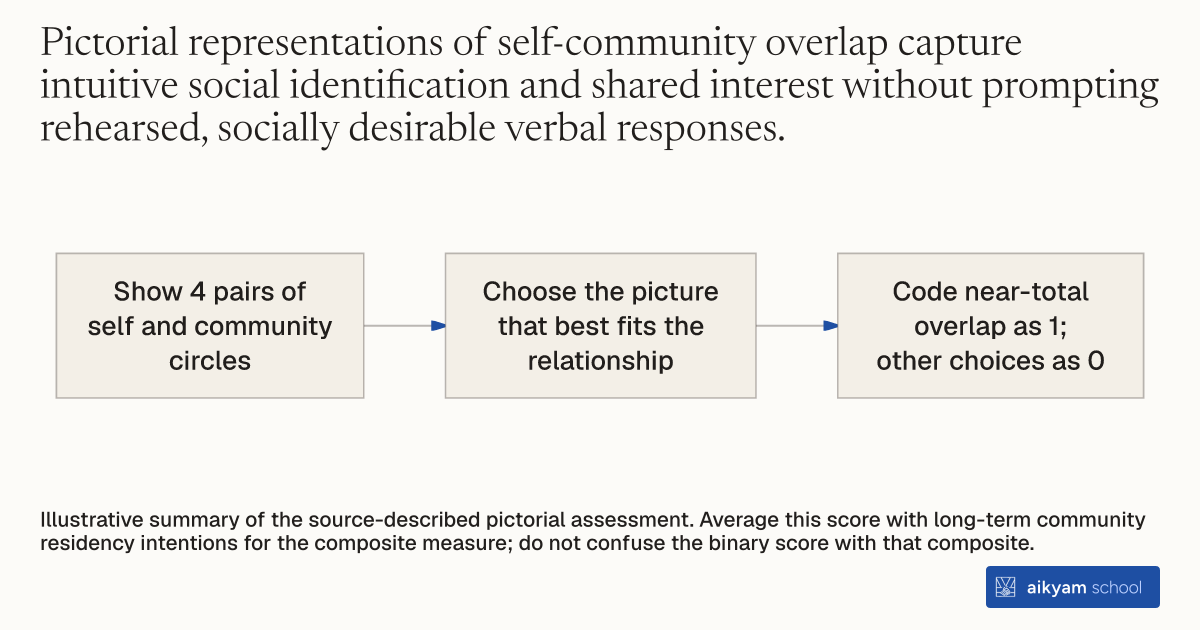
- Show 4 pairs of self and community circles
- Choose the picture that best fits the relationship
- Code near-total overlap as 1; other choices as 0
Illustrative summary of the source-described pictorial assessment. Average this score with long-term community residency intentions for the composite measure; do not confuse the binary score with that composite.
See source →How
When to use
Organizations recruiting public service workers need to measure candidate prosocial motivation and community connectedness without relying on easily manipulated survey statements. Direct self-reported questions about altruism often suffer from social desirability bias and strategic answers. Administering a visual pictorial scale that measures perceived overlap between individual self-interest and community identity provides a validated metric of prosocial alignment.
Measure prosocial motivation and community connectedness using a visual single-item pictorial scale during candidate interviews or baseline surveys.
- Survey enumerators present job applicants or workers with a set of four standardized diagrammatic pictures.
- Each picture displays two distinct circles labeled "self" and "community" with varying degrees of overlap, ranging from completely separate to almost completely overlapping.
- Enumerators instruct respondents to choose the single picture that best represents their personal relationship with their local community.
- Surveyors code the variable as 1 if the respondent selects the almost completely overlapping picture, and 0 otherwise.
- Survey analysts average this pictorial score with long-term community residency intentions to construct a composite prosociality metric.
Why it works
Measuring social identity overlap reliably identifies individuals whose personal utility aligns closely with community welfare.
Example
Researchers administered the Inclusion of Others in Self pictorial scale to 1,585 interviewed job applicants across 48 rural health districts in Zambia. The resulting composite prosociality score averaged 2.51 in control districts and 2.34 in career treatment districts. Selection panels chose top-ranked candidates across both districts who maintained high prosociality scores averaging 2.55.
About the study
Participants
1,585 interviewed applicants for the Community Health Assistant role across 48 rural districts in Zambia (average age 26, 30 percent female).
Study Design
Cross-sectional psychometric assessment administered during face-to-face recruitment interviews, combining the IOS pictorial scale with long-term residency preference to construct a baseline prosociality index.
Results
Control applicants averaged a prosociality index of 2.51 compared to 2.34 among career treatment applicants (p=0.237). Selection panels prioritized top candidate ranks where prosociality differences between treatment and control were zero (2.55 vs 2.55, p=0.91).