Research steps
Test pupils independently through the year
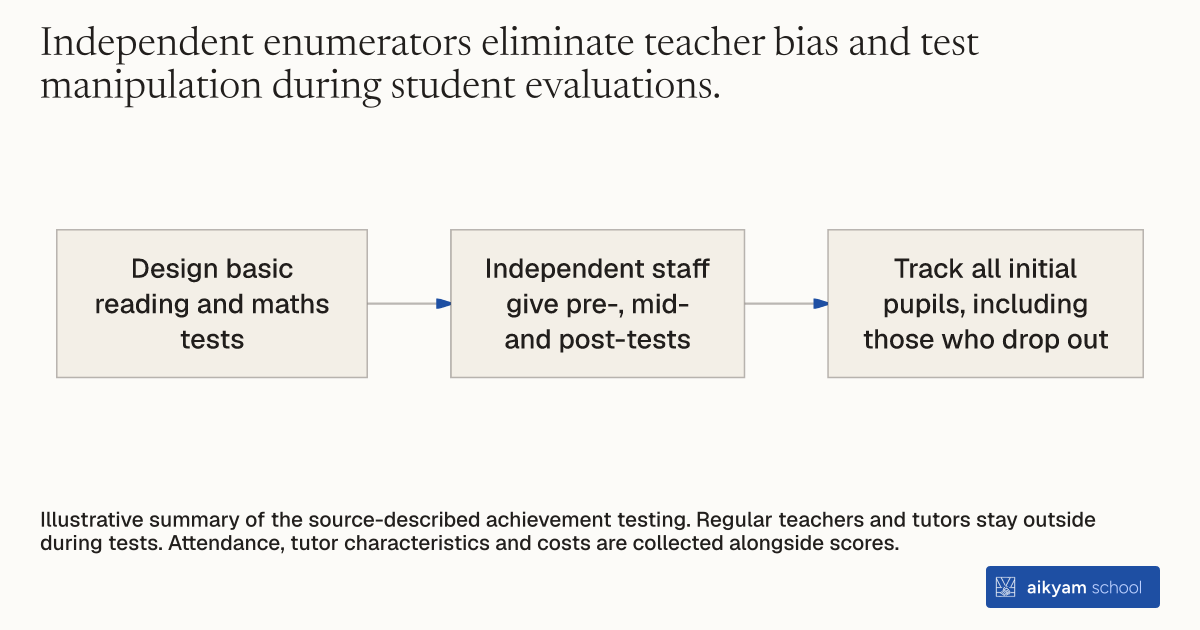
- Design basic reading and maths tests
- Independent staff give pre-, mid- and post-tests
- Track all initial pupils, including those who drop out
Illustrative summary of the source-described achievement testing. Regular teachers and tutors stay outside during tests. Attendance, tutor characteristics and costs are collected alongside scores.
See source →How
When to use
Schools and education programs often lack reliable data on whether children master basic learning competencies. Regular classroom teachers may have conflicts of interest when evaluating their own pupils. Program evaluators use independent testing and student tracking to measure student progress and program impact accurately.
Measure student learning gains and retention using independent testing administered by external enumerators across the school year.
- Education experts design custom math and reading achievement tests focused on basic competencies like number recognition, counting, and simple word problems.
- Research managers hire independent local enumerators to conduct assessments instead of using classroom teachers.
- Enumerators exclude regular classroom teachers and remedial tutors from the room during testing sessions.
- Enumerators administer three test rounds: a pretest at the start of the year, a mid-test, and a posttest at the end of the year.
- Evaluators track all students enrolled at the start of the year, including those who drop out during the term.
- Research staff collect process data on attendance, tutor characteristics, and costs alongside student test scores.
Why it works
Tracking all initially enrolled children prevents dropout attrition from skewing learning outcome data.
Example
In government primary schools across Vadodara and Mumbai, researchers hired local enumerators to administer pretests, mid-tests, and posttests while keeping regular teachers and tutors out of class. Tracking all enrolled pupils across two years allowed researchers to detect an overall test score gain of 0.27 standard deviations from the remedial program.
About the study
Participants
Primary school children in Grades 2, 3, and 4 across 123 government schools in Vadodara and one school district in Mumbai, India.
Study Design
Randomized rollout evaluation from 2001 to 2002 using independent external enumerators to administer pretests, mid-tests, and posttests while tracking all enrolled pupils.
Results
Overall test scores increased by 0.27 standard deviations in Year 2, and the proportion of bottom-third students passing basic competencies rose by 7.7 percentage points.