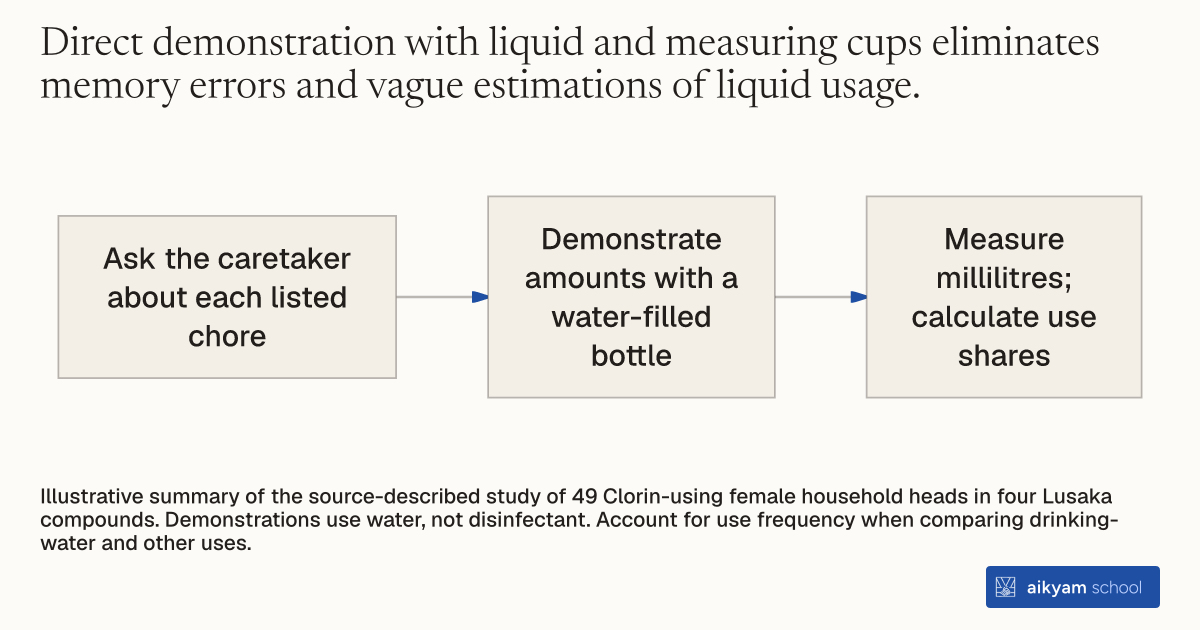
Research steps
Measure product used for household chores
- Ask the caretaker about each listed chore
- Demonstrate amounts with a water-filled bottle
- Measure millilitres; calculate use shares
Illustrative summary of the source-described study of 49 Clorin-using female household heads in four Lusaka compounds. Demonstrations use water, not disinfectant. Account for use frequency when comparing drinking-water and other uses.
See source →How
When to use
Subsidized health products often have alternative non-health uses, leading households to divert products away from primary health purposes. Survey questions without practical demonstrations understate product diversion to domestic chores. This method quantifies the volume of health products diverted to alternative household tasks through hands-on chore demonstrations.
Quantify product volume allocated to specific domestic chores using guided demonstrations and measuring cups.
- An interviewer identifies a list of household chores in which the product can be used.
- The interviewer visits a sampled household and asks the primary caretaker if she uses the product for each specific chore.
- If the caretaker reports using the product for a chore, the interviewer provides a bottle of the product filled with water.
- The caretaker demonstrates the exact amount of product she pours when performing that chore.
- The interviewer pours the demonstrated liquid into a calibrated measuring cup to record the exact volume in milliliters.
- The interviewer calculates the total proportion of product volume allocated across primary health applications versus secondary household chores.
Why it works
Listing specific chores individually helps caretakers recall secondary product uses that general survey questions miss.
Example
Interviewers visited a sample of 49 Clorin-using female heads of household across four compounds in Lusaka, Zambia, measuring liquid used for domestic chores. The measurements revealed that 61 percent of households used Clorin for non-drinking water tasks like washing clothes and cleaning toilets, devoting an average of 38 percent of total purchased product volume to non-drinking water uses.
About the study
Participants
49 Clorin-using female heads of household across four compounds in Lusaka, Zambia.
Study Design
In-depth interview study over six days where caretakers demonstrated chore-specific product usage with water-filled bottles, and interviewers measured liquid volumes in measuring cups across identified domestic tasks.
Results
Sixty-one percent of respondents reported using Clorin for non-drinking water tasks, compared to 96 percent using it in drinking water. On average, households devoted 38 percent of total purchased Clorin by volume to non-drinking water uses, primarily washing clothes and cleaning toilets.