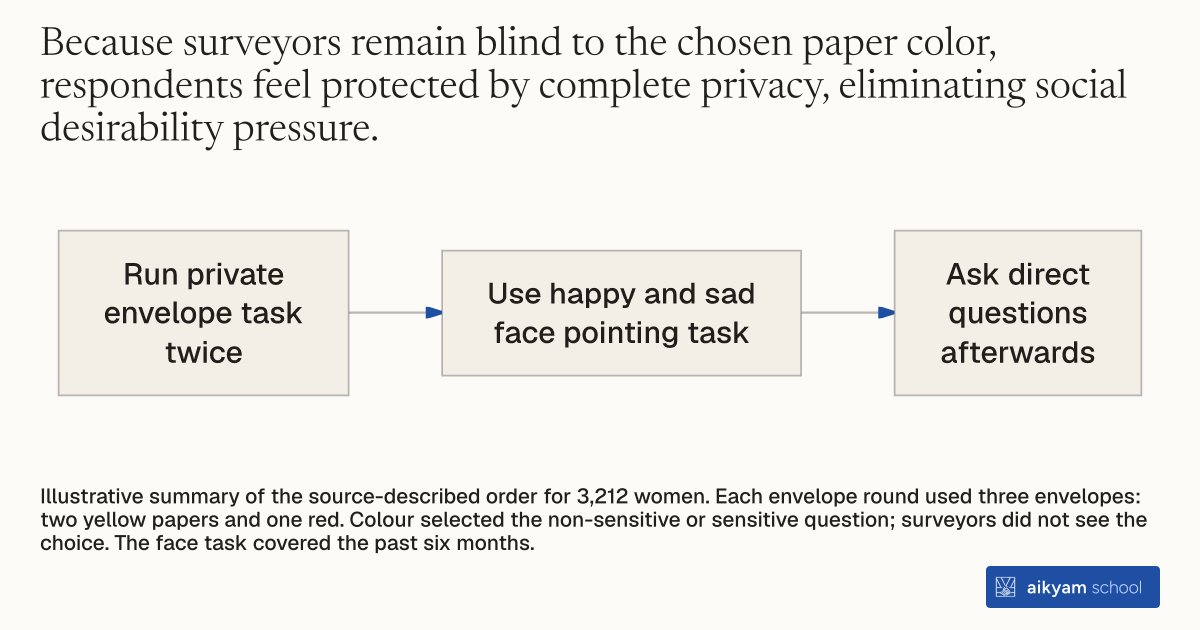
Research steps
Measure sensitive outcomes indirectly
- Run private envelope task twice
- Use happy and sad face pointing task
- Ask direct questions afterwards
Illustrative summary of the source-described order for 3,212 women. Each envelope round used three envelopes: two yellow papers and one red. Colour selected the non-sensitive or sensitive question; surveyors did not see the choice. The face task covered the past six months.
See source →How
When to use
Direct self-reports of sensitive or stigmatized behaviors like intimate partner violence often suffer from social desirability and reporting bias. This method measures sensitive personal outcomes indirectly using anonymous paper envelopes and visual face-pointing tasks. It serves research teams evaluating stigmatized behaviors in low-resource field settings.
Measure sensitive household behaviors indirectly by conducting two non-observable survey tasks prior to direct questioning.
- Female field officers present participants with three identical envelopes containing two yellow papers and one red paper.
- Participants shuffle the envelopes and privately select one without the surveyor watching.
- Field officers read two distinct yes-or-no questions: a non-sensitive control question for yellow paper, and a sensitive target question for red paper.
- Participants answer yes or no based on their private paper color, keeping the surveyor blind to which question they answered.
- Field officers repeat the envelope task in a second round pairing a non-sensitive question with a second sensitive topic.
- Field officers present a sheet with a happy face and a sad face, instructing participants to point to the sad face if sensitive events occurred in the past six months.
Why it works
This privacy encourages truthful reporting on sensitive topics that respondents would otherwise underreport or withhold in direct questioning.
Example
In Nakuru County, Kenya, researchers administered envelope and smiley tasks to 3,212 female participants during intimate partner violence surveys. While direct self-reports initially suggested that psychotherapy increased intimate partner violence by 0.24 standard deviations, the indirect envelope and smiley tasks showed no increase in violence, revealing that the direct effect was driven by reporting comfort rather than actual violence.
About the study
Participants
3,212 female respondents cohabiting or married to a man, surveyed across 233 rural villages in Nakuru County, Kenya.
Study Design
A randomized controlled trial incorporating two indirect measurement tasks (a randomized-response envelope task and a visual smiley task) prior to direct self-reports to test for response bias across cash and psychotherapy treatment arms.
Results
Using indirect envelope and smiley tasks eliminated the 0.24 standard deviation increase in reported intimate partner violence observed under direct self-reports for PM+ recipients, showing no statistically significant change in actual violence.