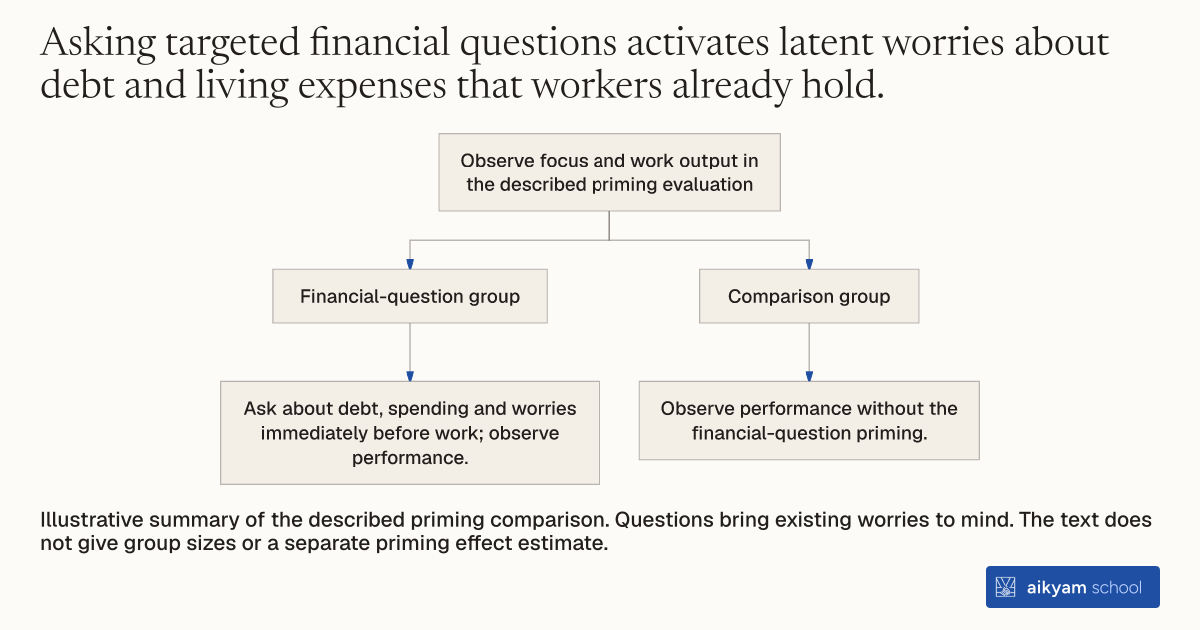
Research comparison
Compare work after financial-worry questions
Observe focus and work output in the described priming evaluation
- Financial-question group
- Ask about debt, spending and worries immediately before work; observe performance.
- Comparison group
- Observe performance without the financial-question priming.
Illustrative summary of the described priming comparison. Questions bring existing worries to mind. The text does not give group sizes or a separate priming effect estimate.
See source →How
When to use
Low-income wage workers hold underlying financial worries that can be brought top of mind by situational prompts. Evaluators need to test whether highlighting existing financial strains alters worker focus and cognitive performance. Survey priming brings latent economic worries top of mind without creating new financial burdens.
Bring existing financial thoughts top of mind by asking targeted financial questions before cognitive or work tasks.
- Design survey questions that ask workers about their personal debt obligations, household expenditures, and financial worries.
- Administer the financial survey module to treatment group workers immediately prior to work execution.
- Observe how bringing financial worries top of mind impacts immediate cognitive focus and work output.
- Compare performance metrics against a comparison group who did not receive the financial survey priming.
Why it works
Bringing these thoughts top of mind consumes working memory and lowers cognitive focus during active work tasks.
Example
In Odisha, India, researchers administered survey priming questions to low-income leaf-plate workers to bring existing financial thoughts top of mind during the evaluation.
About the study
Participants
408 human male wage laborers aged 18–55 across 47 villages in Odisha, India.
Study Design
Survey priming intervention designed to bring existing latent financial thoughts top of mind before evaluating worker productivity and attentiveness during a 12-day manufacturing contract.
Results
Baseline surveys confirmed 83 percent of workers thought about finances while working and 70 percent were very worried about future finances; priming brought these existing thoughts top of mind to demonstrate cognitive distraction mechanisms.