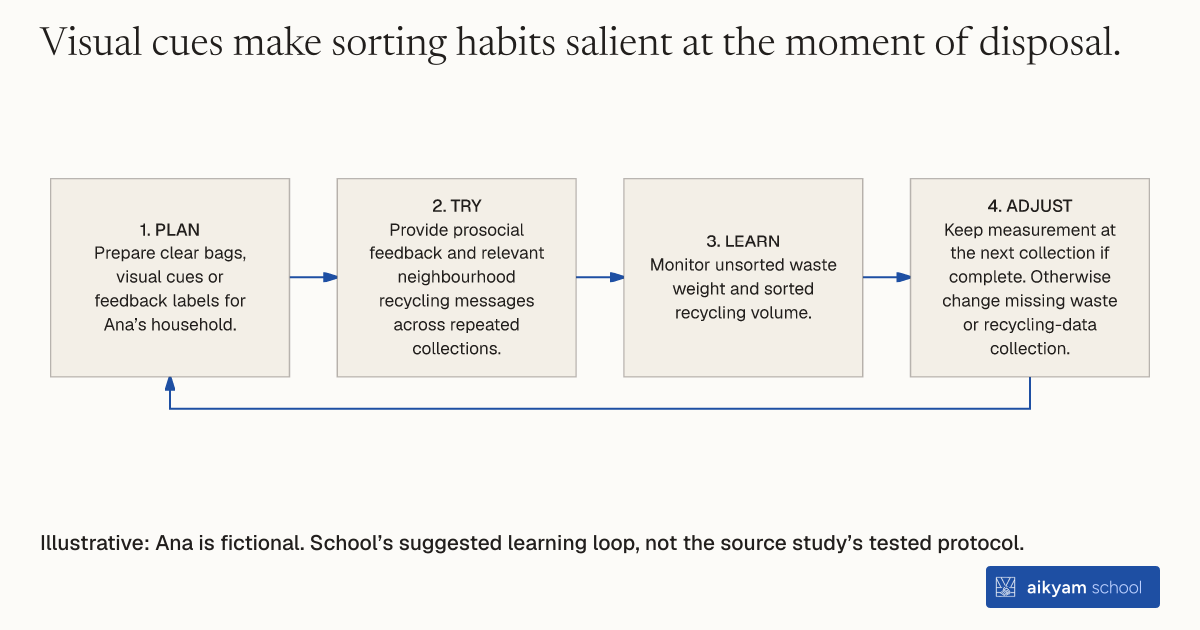
Try, learn and adjust
Check waste sorting across collection cycles
- Plan: Prepare clear bags, visual cues or feedback labels for Ana’s household.
- Try: Provide prosocial feedback and relevant neighbourhood recycling messages across repeated collections.
- Learn: Monitor unsorted waste weight and sorted recycling volume.
- Adjust: Keep measurement at the next collection if complete. Otherwise change missing waste or recycling-data collection.
Illustrative: Ana is fictional. School’s suggested learning loop, not the source study’s tested protocol.
See source →School’s suggested learning loop: observe unsorted waste and recycling volumes. This suggested loop does not isolate the effects of different nudges.
How
When to use
Households frequently dispose of recyclable materials in unsorted waste bins due to a lack of visual prompts and feedback. High contamination in trash streams increases landfill volume and municipal disposal costs. Informational nudges and prosocial feedback encourage households to separate recyclables without imposing financial penalties.
Deliver visual nudges and prosocial feedback to households to increase recycling and reduce unsorted waste.
- Provide clear trash bags, visual cues, or feedback labels on residential waste collection containers.
- Print prosocial feedback symbols, such as smiley or sad faces, directly on household recycling communication reports.
- Distribute social norm messages highlighting neighborhood recycling benchmarks to lower-performing households.
- Maintain continuous exposure to visual nudges across repeated garbage collection cycles.
- Monitor changes in unsorted waste weights and sorted recycling volumes across targeted residential neighborhoods.
Why it works
Prosocial feedback leverages emotional norms and social approval to reinforce positive recycling habits.
Example
Municipal interventions in the United Kingdom, Canada, and Italy tested clear trash bag policies, visual prompts, and prosocial feedback. Evaluators found that nudges reduced unsorted solid waste, with prosocial feedback like smiley faces boosting recycling rates particularly among lower-income households.
About the study
Participants
Residential households across the United Kingdom, Canada, and Italy across seven evaluations.
Study Design
Randomized controlled trials and regression discontinuity designs evaluating household waste weights and recycling participation rates.
Results
Informational nudges effectively reduced unsorted waste and raised recycling rates. Prosocial feedback increased recycling more than social comparison reports, though social comparisons produced the largest shifts among households that previously did not recycle.